 i
i 





|
बी एड - एम एड >> बी.एड. सेमेस्टर-1 प्रश्नपत्र-I - फिलासफिकल पर्सपेक्टिव आफ एजुकेशन बी.एड. सेमेस्टर-1 प्रश्नपत्र-I - फिलासफिकल पर्सपेक्टिव आफ एजुकेशनसरल प्रश्नोत्तर समूह
|
|
|||||||

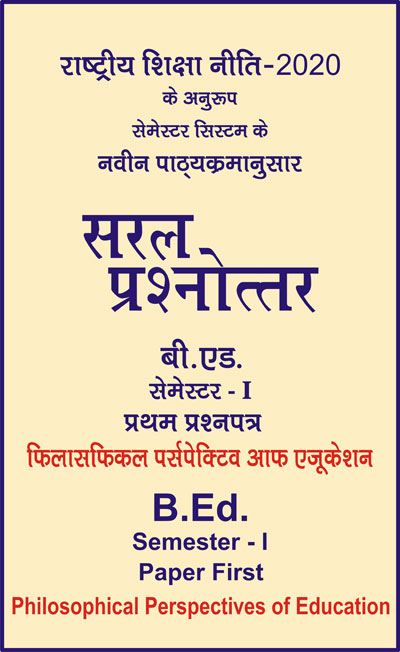

बी.एड. सेमेस्टर-1 प्रश्नपत्र-I - फिलासफिकल पर्सपेक्टिव आफ एजुकेशन (अंग्रेजी भाषा में)
Question- State the Philosophy of education and Educational Thoughts of Vivekananda in your words.
Or
Elucidate on Educational thoughts of Vivekananda.
Or
Describe the meaning of Education according to Swami Vivekanand.
Answer -
“Vivekananda’s Educational Thought”
Meaning of Education
It should be remembered here, as long as Vivekananda’s educational thoughts are concerned that education is not the mass of informations which are inserted by force into the mind of a child. In his own words - “Education is the manifestation of perfection already reached in man.”
Aims of Education of Vivekananda
According to Swami Vivekanand the following factors should be the main aims of education:
(1) Reaching Perfection: The prime aim of education is to achieve fulness of perfection already present in a child. According to Swamiji all material and spiritual knowledge is already present in man covered by a curtain of ignorance. Education should tear off that veil so that the knowledge shines forth as an illuminating torch to enliven all the corners by and by.
(2) Physical and Psychological Development: As for as Vivekananda's principle of education is concerned, the second aim of education is the development of physical and psychological awareness so that the child of today, after studying Geeta, should be able to promote National Growth and advancement as a fearless and physically well-developed citizen of tomorrow.
(3) Moral and Spiritual Development: According to Swami Vivekanand, a nation's greatness is not only measured by its parliamentary institutions and activities, but also by the greatness of its citizens. But the greatness of citizens is possible only through their moral and spiritual development which education should foster.
(4) Aim of Character Development: According to Swamiji character development is a very important aim of any education, and to achieve this, he emphasized the practice of Brahmacharya.
(5) The Aim of Developing Faiths in Shraddha and a Spirit of Renunciation: All through his life Swamiji exhorted the individuals to keep full confidence upon their powers. They should inculcate a spirit of self-surrender, sacrifice and renunciation of material pleasures for the good of others. He gave this call to his countrymen - “Arise, awake and stop not till the goal is achieved.”
(6) The Aim of Searching Unity in Diversity: The true aim of education is to develop insight into the individuals so that they are able to search out and realize unity in diversity. Swami Vivekanandji has further asserted that physical and spiritual worlds are one.
(7) Aim of Religious Development: To Swamiji, religious development is an essential aim of education. To him, each individual should be able to search out and develop the religious seed embedded in him and this finds the absolute truth or reality. Hence, he advocated the training of feelings and capacities of obedience, social and sublimated.
Curriculum
According to Swami Vivekanand, the prime aim of education is spiritual growth and development. But this does not mean that he did not advocate material prosperity and physical well-being. For spiritual perfection Swamiji prescribed Religion, Philosophy, Puranic lore, Upanishads, company of saints and their preachings and for material advancement and prosperity, he recommended Languages, Geography, Science, Political Science, Economics, Psychology, Art, Agriculture, Industrial and Technical subjects together with Games.
|
|||||
अन्य पुस्तकें
एम ए सेमेस्टर-1 - अंग्रेजी - प्रथम प्रश्नपत्र - अंग्रेजी साहित्य 14वीं-17वीं शताब्दी
सरल प्रश्नोत्तर समूह
मूल्य: Rs. 400