
 i
i 





|
बी एड - एम एड >> बी.एड. सेमेस्टर-1 प्रश्नपत्र-I - फिलासफिकल पर्सपेक्टिव आफ एजुकेशन बी.एड. सेमेस्टर-1 प्रश्नपत्र-I - फिलासफिकल पर्सपेक्टिव आफ एजुकेशनसरल प्रश्नोत्तर समूह
|
|
|||||||

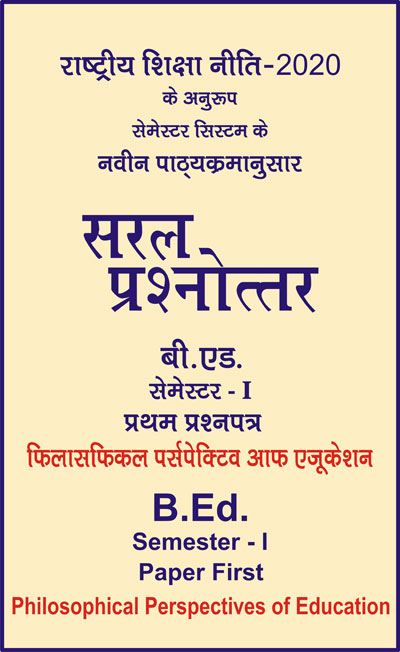

बी.एड. सेमेस्टर-1 प्रश्नपत्र-I - फिलासफिकल पर्सपेक्टिव आफ एजुकेशन (अंग्रेजी भाषा में)
Question- Describe the salient features of scientific Humanism in the field of education ?
Or
Scientific Humanism is known as Secular Humanism as it emphasis on secular values and democratic humanism. Discuss.
Or
What is Humanism in Education ?
Answer -
Introduction : The concept of Humanism is most popular in the western countries now a days. It is also known as scientific humanism as it has firm faith in science and scientific values. It is too called as secular humanism due to its emphasis on secular values and democratic humanism due to it believed in democracy. Corliss Lamont has summarised the salient features of scientific humanism in the following ten central propositions :
-
Humanism believes in a naturalistic metaphysics or attitude towards the universe that considers all forms of supernatural as myth.
-
Humanism, drawing especially upon the laws and facts of science believes that man is an evolutionary product of this great nature of which he is a part.
-
Humanism, Possesses its faith in man and believes that human beings process the power of potentiality of solving their own problems.
-
Humanism believes in opposition to all theories of universal predestination, determinism or fatalism, that human beings, while conditioned by the past, possess genuine freedom of creative choice and action, and are, within certain objective limits, the masters of their own destiny.
-
Humanism believes in an ethics or morality that grounds all human values in this-earthly experiences and relationships. Its highest goal is wordly happiness.
-
Humanism believes that the individual attains the good life by harmoniously combining personal satisfactions and continuous self-development.
-
Humanism believes in the widest possible development of art and the awareness of beauty, including the appreciation of Nature’s loveliness and splendour, so that the aesthetic experiences may become a pervasive reality in the life of man.
-
Humanism believes in a far-reaching social programme that stands for the establishment throughout the world of democracy, peace and a high standard of living.
-
Humanism believes in the complete social implementation of reason and scientific method; and in the use of democratic procedures.
-
Humanism believes in the unending questioning of basis assumptions and convictions including its own.
|
|||||
अन्य पुस्तकें

एम ए सेमेस्टर-1 - अंग्रेजी - प्रथम प्रश्नपत्र - अंग्रेजी साहित्य 14वीं-17वीं शताब्दी
सरल प्रश्नोत्तर समूह
मूल्य: Rs. 400