 i
i 





|
बी एड - एम एड >> बी.एड. सेमेस्टर-1 प्रश्नपत्र-I - फिलासफिकल पर्सपेक्टिव आफ एजुकेशन बी.एड. सेमेस्टर-1 प्रश्नपत्र-I - फिलासफिकल पर्सपेक्टिव आफ एजुकेशनसरल प्रश्नोत्तर समूह
|
|
|||||||

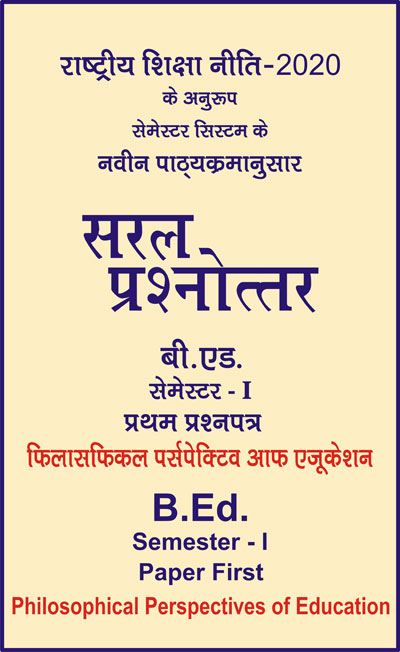

बी.एड. सेमेस्टर-1 प्रश्नपत्र-I - फिलासफिकल पर्सपेक्टिव आफ एजुकेशन (अंग्रेजी भाषा में)
Question- 'The education Philosophy of Mahatma Gandhi is a synthesis of Idealism, Pragmatism and Naturalism.' How far do you agree with this statement ? Explain giving concrete example.
Answer -
Gandhi was highly practical personality not only of India but of the world. The world’s greatest physicist Einstein observed about Gandhi,
"Generalization to come will scarce believe that ever a man, in flesh and blood, walked upon this earth." He spokes what he follows. He believes only that truth which bears out in testable situations. In fact, the title of his autobiography is "My experiments with truth". He performed miracles in Indian socio-political life. Likewise he tested all his educational ideas through experimentations in education and then advocated them.
Gandhi was unique educationist. His educational philosophy is a synthesis of Idealism, Pragmatism and Naturalism. Gandhi looks a great Idealist when he advocated the ideals of truth, non-violence and moral values as a tool to achieve the ultimate truth of self-realization. He looks an ardent devotee of Naturalism when he speaks about the development of the child according to his nature. Similarly, he becomes a perfect Pragmatist when he advocates learning by doing and learning by experience. To paint an integrated picture of Gandhi’s educational philosophy Dr. M.S. Patel wisely remarked, "The real greatness of Gandhiji as an educational philosopher consists in the fact that the dominant tendencies of Naturalism, Idealism and Pragmatism are not separate and independent in his philosophy, but they fuse into a unity, giving rise to a theory of the human soul." All three sides of Gandhi’s educational philosophy is given below with suitable examples :
Gandhi’s Idealistic Educational Philosophy : Gandhi’s Idealistic educational philosophy is as follows :
- Gandhi believes in God as ultimate reality. In all his ashrams morning prayers is an essential ritual.
- Gandhi believes in absolute values. He always spoke truth and advocate so.
- No-violence was a creed with Gandhi as an idealist. He was ready to die for his ideas. He also advocates that Non-violence is a weapon of strong.
- He believes in earning one’s own living through hard work. He himself loves to work with his own hand. As a symbol work Gandhi Charkha remains an essential part of schools for long after independence.
- He always teaches that morality should be practiced in its soul and substance.
- He posses a broad religious view and show great tolerance of all other religions.
- His life is a massage for all.
Gandhi’s Naturalist Educational Philosophy : Gandhi’s Naturalist educational philosophy is as follows :
- Nature of the child should not be harmed.
- Education should be child centered. The interests of the child must be taken into consideration while forming curriculum.
- Education should be given in natural surroundings.
Gandhi’s Pragmatist Educational Philosophy : Gandhi’s Pragmatist educational philosophy is follows :
- He believes in action. Satyagraha was his way of expression. He was a Karamyogi.
- Not verbal education but practical education.
- He support learning by doing.
Examples of Synthesis of Gandhi’s Educational Philosophy
Historically, Gandhi’s synthesis of all three philosophical aspects was well observed at the following location :Gandhi opened a school at Phoenix, South Africa in 1904 where education was given both in literacy aspects and training aspects, in agriculture and painting. It was a school cum workshop. He set up an ashram at Transvaal in 1911, Tolstoy Farm for imparting multicultural understanding. In this ashram working with hand and character building was practiced in natural surroundings. In 1917 he opened 6 primary schools in villages of Champaran. Free boarding and lodging facilities were provided to teachers. The curriculum follows 3 R’s formula grammar, cleanliness and good manners.
|
|||||
अन्य पुस्तकें
एम ए सेमेस्टर-1 - अंग्रेजी - प्रथम प्रश्नपत्र - अंग्रेजी साहित्य 14वीं-17वीं शताब्दी
सरल प्रश्नोत्तर समूह
मूल्य: Rs. 400