 i
i 





|
बी एड - एम एड >> बी.एड. सेमेस्टर-1 प्रश्नपत्र-I - फिलासफिकल पर्सपेक्टिव आफ एजुकेशन बी.एड. सेमेस्टर-1 प्रश्नपत्र-I - फिलासफिकल पर्सपेक्टिव आफ एजुकेशनसरल प्रश्नोत्तर समूह
|
|
|||||||

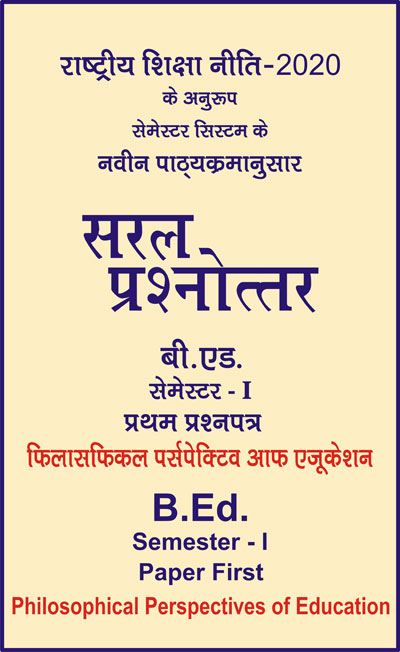

बी.एड. सेमेस्टर-1 प्रश्नपत्र-I - फिलासफिकल पर्सपेक्टिव आफ एजुकेशन (अंग्रेजी भाषा में)
Question- Means of Education in the words of Vivekananda.
Answer -
"Vivekananda Means of Education"
Swamiji was, undoubtly, one of the greatest educationists of his contemporary world. He was much learned than that of his counter parts of contemporary. His relevance to the education with a particular reference to India, can well be ascertained under the following heads -
(1) Love: The best means of education, according to Vivekananda, is love. Education should be based upon love. Love is the best inspiration in character building. The child should be taught through love. The only motive in imparting education should be love for the educand, for the man in him. That is why Vivekanand’s philosophy of education is known as education for man-making. The teacher’s aim should be neither money-making nor attainment of fame but only bestowing human love. This love within the educator is the real source of his influence upon the educand. This may be amply clear by the real example of the relationship of Vivekanand with his Guru Ramakrishna. It was the force of spiritual love in Ramakrishan which helped Vivekanand to God realisation.
(2) Concentration: Concentration, according to ancient Indian thought, is the key to true knowledge. Therefore, Vivekanand has placed much emphasis upon focusing of attention. It is only after years of concentration that a man becomes a scholar and a great scientist. The educands should be distinguished according to their abilities, every one of them has to develop concentration.
Hence, the educator must organise his teaching in such a way that he may be helpful to each educand separately. He should attend to every one’s difficulty and try to solve them as much as possible. Thus Vivekanand supported the ancient Indian means of achieving concentration.
(3) Brahmacharya: Again, according to ancient Indian thinkers, Brahmacharya or abstinence is the first means of achieving concentration. It gives mental and spiritual powers of the highest kind. It transforms sex drive into a spiritual force. Brahmacharya implies purity of thought, deed and action. It helps to improve and sharpen various psychological processes such as learning, remembering, thinking, etc. It helps in achieving power of memory and improve the powers of the mind.
(4) Discussion and Contemplation: In addition to concentration the other means of education are discussion and contemplation. It is only through these that the educand may remove his difficulties. Discussion should be carried out in an informal atmosphere. Contemplation should be practised in a calm and quiet atmosphere with the mind fully alive.
|
|||||
अन्य पुस्तकें
एम ए सेमेस्टर-1 - अंग्रेजी - प्रथम प्रश्नपत्र - अंग्रेजी साहित्य 14वीं-17वीं शताब्दी
सरल प्रश्नोत्तर समूह
मूल्य: Rs. 400