 i
i 





|
बी एड - एम एड >> बी.एड. सेमेस्टर-1 प्रश्नपत्र-I - फिलासफिकल पर्सपेक्टिव आफ एजुकेशन बी.एड. सेमेस्टर-1 प्रश्नपत्र-I - फिलासफिकल पर्सपेक्टिव आफ एजुकेशनसरल प्रश्नोत्तर समूह
|
|
|||||||

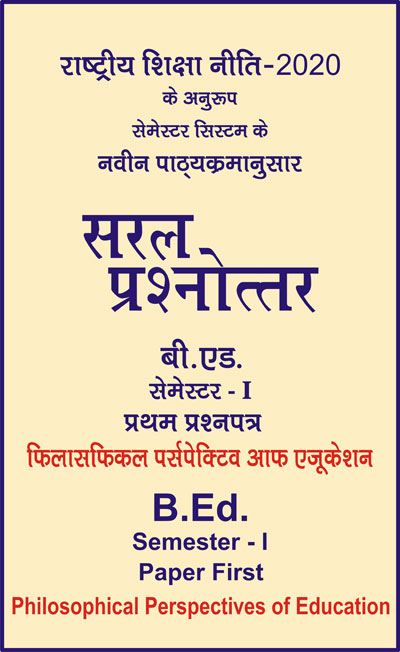

बी.एड. सेमेस्टर-1 प्रश्नपत्र-I - फिलासफिकल पर्सपेक्टिव आफ एजुकेशन (अंग्रेजी भाषा में)
Question- "Vivekanands respected human individuality everywhere and pleaded for freedom for everyone." Do you agree with this statement.
Answer -
Science and Vedanta
With the aim of education as man-making, Vivekanand developed a curriculum which could lead to multisided and all round development of the educand. He tried to synthesise science and Vedanta, modern and ancient knowledge so that the curriculum may involve whatever is best in these. He realised that the curriculum must be able to achieve the development of every aspect of the child’s personality. According to him, what is really needed in India is a harmony between Western Science and Indian Vedanta. If this is not done, it may lead to improper use of science in the form of invention of destructive weapons.
Training in Art
Besides the provision of science and Vedanta, Vivekanand considered art as an indispensable part of the curriculum. Education in science must be supplemented by training in art. According to Vivekananda, while Asians specialised in Art, the West developed science and both are necessary for modern man. The ideal of utility should be substituted by the ideal of duty through the teaching of art.
Medium of Instruction
In the teaching of languages, Vivekanand laid particular stress upon teaching through the mother-tongue. Here he is supported by all other contemporary Indian philosophers of education. Besides mother tongue, there should be a common language which is necessary to keep the country united. This may be taught in addition to the regional languages. The teaching of Sanskrit forms an important part of the curriculum envisaged by Vivekanand. Sanskrit is the source of all Indian languages and a repository of all inherited knowledge. It is, therefore, absolutely necessary that every Indian should know Sanskrit. Vivekanand appreciated the greatness of Sanskrit in eloquent words when he said that this language granted power, ability and prestige to the nation and that our awareness of our cultural heritage and past greatness depends very much upon our knowledge of this language.
Physical Education: Vivekanand laid particular stress on the value of physical education in curriculum. He said, "You will be nearer to Heaven through football than through the study of Gita. You will understand Gita better by your biceps, your muscles a little stronger... you will understand the Upanishads better and the glory of the Atman, when your body stand firm on your feet and you feel yourself as man." Self-realisation or character building is impossible in the absence of physical education. One must know the secret of making the body strong through physical education.
Moral and Religious Education of Vivekanand: Laying emphasis upon religious education, Vivekanand said, "Religion is the innermost core of education. I do not mean my own or any one else's opinion about religion. Religion is as the rice and everything else, like the curries. Taking only curries indigestion, and so is the case with taking rice alone." Therefore, religious education is a vital part of a sound curriculum.
Vivekananda did not distinguish between secular and religious education. He thought that the former may be given by the latter. He said, "We have to give them secular education. We have to follow the plan laid down by our ancestors, that is to bring all the ideals slowly down among the masses. Raise them slowly up, raise them to equality. Impart... secular knowledge through religion."
Vivekanand respected human individuality everywhere and pleaded for freedom for everyone. Each soul, according to him, "is potentially divine. The goal is to manifest this Divinity within by controlling nature, external and internal. Do this, either by work, or worship, or psychic centre of philosophy - by one or more or all of these - and be free. This is the whole or religion. Doctrines or dogmas, or rituals or books, temples or forms are secondary details."
|
|||||
अन्य पुस्तकें
एम ए सेमेस्टर-1 - अंग्रेजी - प्रथम प्रश्नपत्र - अंग्रेजी साहित्य 14वीं-17वीं शताब्दी
सरल प्रश्नोत्तर समूह
मूल्य: Rs. 400