 i
i 





|
बी एड - एम एड >> बी.एड. सेमेस्टर-1 प्रश्नपत्र-I - फिलासफिकल पर्सपेक्टिव आफ एजुकेशन बी.एड. सेमेस्टर-1 प्रश्नपत्र-I - फिलासफिकल पर्सपेक्टिव आफ एजुकेशनसरल प्रश्नोत्तर समूह
|
|
|||||||

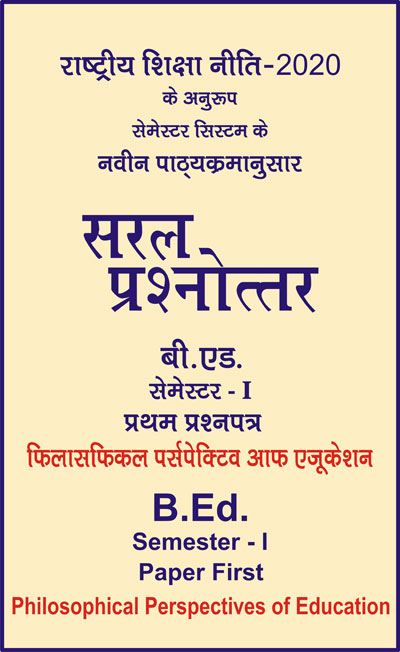

बी.एड. सेमेस्टर-1 प्रश्नपत्र-I - फिलासफिकल पर्सपेक्टिव आफ एजुकेशन (अंग्रेजी भाषा में)
Question- Describe education philosophy of Gijjubhai.
Answer -
Gijubhai Education Philosophy: Gijubhai Badheka (15 November 1885 – 23 June 1939) was an educator who helped to introduce Montessori education. He is referred to as "Moochhali Maa". Badheka was a High Court lawyer, however, following the birth of his son in 1923, he developed an interest in childhood development and education. In 1920, Badheka founded the “Bal Mandir” pre-school. Badheka published a number of works in the field of education including Divaswapna ("Daydreams").
In 1920, Badheka founded the Bal Mandir kindergarten. Later, Nanabhai Bahatt, Harbhai Trivedi and Badheka built the “Shree Dakshinamurti Gijubhai Vinay Mandir” school in Bhavnagar.
After the completion of his schooling, Gijubhai got admission in Shamaldas College, but for reasons unknown, he was not able to complete his studies. In 1907, he was sent to East Africa by his family to earn a living. This is where he met S.P. Stevens, a solicitor who impressed upon Gijubhai the need for self-reliance – the utter refusal to depend on anybody but yourself – and Stevens put this into practice on a daily basis in his life. It was a wonder to Gijubhai to see how Stevens made his life without banking on anyone for anything and that it was possible, in fact exhilarating, to figure things out and work single-handedly.
On his return to India in 1910, Gijubhai studied law in Mumbai. He started his legal practice in 1911 as a district pleader and in the following year enrolled himself as a High Court pleader. On the personal front, it is believed, it was his mother’s brother, Hargovind Pandya, who inspired him. Gijubhai married twice. His first wife was Hiraben whom he married in 1902 when he was just seventeen. But Hiraben passed away young and then he married Jariben in 1906. Gijubhai became a father in 1913 when a son was born to him. Soon after his birth, when the young father picked up his little boy, for a few minutes he was sad and anxious. His own childhood flashed before his eyes. After all, like every child from a respectable family, his son too would have to go to school. And school for Gijubhai meant being caned daily for the slightest misdemeanour. As he held his newborn, Gijubhai knew that this little fellow too would have to go to school – a land of small terrors. “Wasn’t there a way out? Couldn’t there be a better way to teach and learn?” Gijubhai started asking questions.
The real purpose of education, Gijubhai felt, was to have a teacher that understood the children that he/she was educating. If the child spent five or more hours with one person, five days a week, shouldn’t the child also get to love and genuinely respect the teacher?
Gijubhai, like all parents, wanted his son to be happy, safe and comfortable all through his life. He also realised that all parents forced their kids went to school, and the best schools of the time had teachers who only knew how to teach through fear. Gijubhai felt that if children were treated with respect and there were enough meaningful learning opportunities, no child would abhor coming to school. In fact, they would look forward to being in a place where there were so many children and an adult who helped them explore the world around them. Could that be possible? Gijubhai worried about it. He turned to reading and researching. This is how he stumbled upon Maria Montessori and all that she had been working on.
All these readings taught Gijubhai the Montessori education system, wherein the role of an adult or a teacher is to only help unfold the hidden and inborn developmental powers of the child. The child already possesses everything; the adult is just a facilitator. Maria Montessori believed that the child must be guided in the path of reaching adulthood because, from the earliest moments of life, children are possessed with great constructive energies that guide the formation of their mind and the coordination of their bodies.
Gijubhai devoured the book on the Montessori Method. It was an introduction to another microcosm wherein teaching was done using the ‘play-way’ method. Enthused by all that he was learning, Gijubhai started spending more time with teachers and schools. Convinced that he had to be the change, in 1915, he assisted in the establishment of Dakshinamurti (Bala Bhavan) and then started a hostel at Bhavnagar. In 1916, he gave up his legal practice and joined Dakshinamurti as an assistant superintendent.
Gijubhai’s contribution was the evolution of a system of child education suitable to the Indian environment, the training of teachers, and the creation of a body of literature for children. While liberally borrowing from the educational philosophies of Montessori, Frobel, Dalton, and others, he developed a system that integrated music, dance, travel, storytelling, and outdoor play to fit Indian requirements. Freedom and love were the twin principles around which the system revolved. The school was an instant success.
Mahatma Gandhi, who himself had clear thoughts and views on learning, was very fond of Gijubhai Badheka. It was he who called Gijubhai ‘Moochali Ma’, meaning ‘Mother with Whiskers’, and the name stayed.
|
|||||
अन्य पुस्तकें
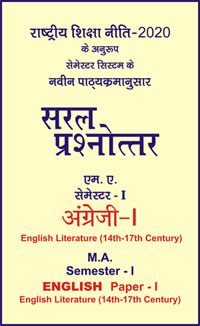
एम ए सेमेस्टर-1 - अंग्रेजी - प्रथम प्रश्नपत्र - अंग्रेजी साहित्य 14वीं-17वीं शताब्दी
सरल प्रश्नोत्तर समूह
मूल्य: Rs. 400