 i
i 





|
बी एड - एम एड >> बी.एड. सेमेस्टर-1 प्रश्नपत्र-I - फिलासफिकल पर्सपेक्टिव आफ एजुकेशन बी.एड. सेमेस्टर-1 प्रश्नपत्र-I - फिलासफिकल पर्सपेक्टिव आफ एजुकेशनसरल प्रश्नोत्तर समूह
|
|
|||||||

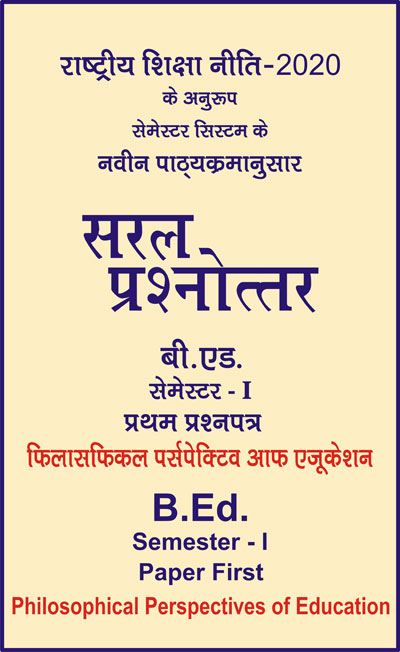

बी.एड. सेमेस्टर-1 प्रश्नपत्र-I - फिलासफिकल पर्सपेक्टिव आफ एजुकेशन (अंग्रेजी भाषा में)
Question- Explain the Educational thought of J.K. Krishnamurthi in view of modern educational behaviour.
Or
Clarify that real Education teaches us to view the world objectively with respect to educational thoughts of J. Krishna Murthi.
Or
Contemporary system of education emphasises storing of information and it worsens structure of education, as long as Krishna Murthi is concerned.
Or
Write an essay on relevance of educational thoughts of J. Krishnamurti in present context.
Answer -
Educational Thought
Importance of Education: Krishnamurti gave special attention to the problem of the younger generation. He lamented that children do not hear their parents. They do not care about what their parents want. They do not want to learn the pattern of behaviour from their parents. Though Krishnamurti was not a traditionalist he gave much importance to child care and child rearing. He maintained that we have to develop a generation free from fear, disagreeing with the past, rational and using discretion.
Aims and Objectives of Education
Advising the young students Krishnamurti said, "To be really educated means not to conform, not to imitate, not to do what millions and millions are doing. If you feel like doing that do it. But be awake to what you are doing." Education aims at preparing the new generation for a new life. It is neither collecting information, nor passing examination or achieving degrees or attaining skills.
Krishnamurti saw that everywhere in the world, there is violence in thought and violence in action. There is physical and violence and violence of repression. There is violence of obedience and violence of competition. There is violence in naturalism, violence in inter-relation of nation and communities. When an individual becomes aware of this disorder he attains liberation. This liberation is real education.
Role of the Teacher
The teacher is supposed to help the students in the proper process of education so that along with bookish knowledge they may also know themselves. Thus, in the tradition of ancient Indian educators, Krishnamurti defined education as self-realisation. Along with the knowledge of different subjects, the educational process should develop an insight into the working of intellect and basic tendencies. This is not done in the modern system of education. Therefore, the new generation revolt against meaningless standardised life.
Freedom and Discipline
According to Krishnamurti, there should be complete freedom in the process of time education so that the entire power of the mind may be used. Education must be overall. An educated person must live a life of wisdom and understanding. Krishnamurti said, "Education is to help us to be same, non-mechanical and intelligent." Education creates wisdom which works in this world. Education must create full consciousness of present life. It should help us to lead an absolutely free and wise life in the present, free from ideas of past and future. According to Krishnamurti, every educated person must see the world through his own eyes, his own and his own freedom.
Contribution As a Teacher Educator
- He regarded the Child as God. 'Bal Devo Bhava'.
- He tried to understand the importance of child.
- He told the child stories which are interesting and recreational.
- He encouraged the children to tell stories and gave hearing to them.
- When children come to school he welcomed them, called them by name, loved them and greeted them with a smile.
- He taught the children folk songs.
- He taught history, grammar, riddle, geography, drama through play.
- He took children to rivers, mountains, forests, museums and other places.
- He said the greatest crime of the world is to abuse and beat the children.
- He praised their creativity.
|
|||||
अन्य पुस्तकें
एम ए सेमेस्टर-1 - अंग्रेजी - प्रथम प्रश्नपत्र - अंग्रेजी साहित्य 14वीं-17वीं शताब्दी
सरल प्रश्नोत्तर समूह
मूल्य: Rs. 400