 i
i 





|
बी एड - एम एड >> बी.एड. सेमेस्टर-1 प्रश्नपत्र-I - फिलासफिकल पर्सपेक्टिव आफ एजुकेशन बी.एड. सेमेस्टर-1 प्रश्नपत्र-I - फिलासफिकल पर्सपेक्टिव आफ एजुकेशनसरल प्रश्नोत्तर समूह
|
|
|||||||

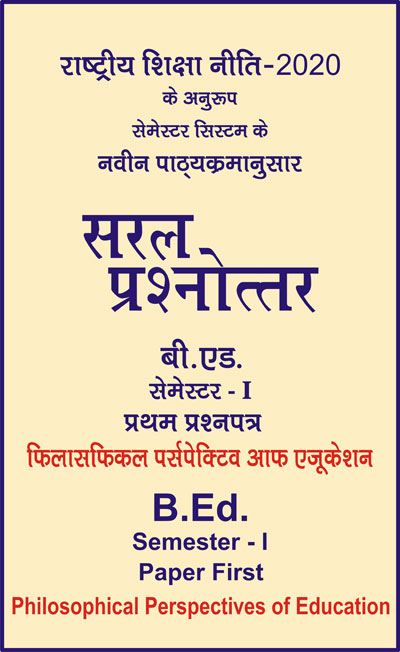

बी.एड. सेमेस्टर-1 प्रश्नपत्र-I - फिलासफिकल पर्सपेक्टिव आफ एजुकेशन (अंग्रेजी भाषा में)
Question- Describe his Educational Method and his Discipline.
Or
"What is Rousseau’s concept of negative education"? Explain with examples.
Answer -
Educational Method
As the method generally pursued in education in his time was mainly oral and theoretical, Rousseau criticised the prevalent teaching methods. He said, “I want that some wise man should tell us the art of counselling the child. This art will be valuable for us.” Rousseau wanted to adopt the play-way method in education in place of verbal teaching. The infant himself learns to develop by utilisation of his sense organs and reacting to the environment.
Principles of Education : Rousseau is a naturalist in his methodology of education just as much as he is a naturalist in the curriculum of education. He has stressed the importance of the two following principles governing the process of education.
1. Learning Through Self-experience : Rousseau wanted to educate Emile through experience and not through books. He was opposed to bookish education because he contended that books try to teach one to talk about those things which one does not, in fact, know.
2. Learning Through Doing : Rousseau opposed the rote method of learning on the ground that knowledge acquired through actual doing or actual experience is far more permanent than knowledge acquired through words. He wanted the child’s power of reasoning and not his power of memorising things to be developed. That is why Rousseau was so severely critical of the existing methods of education. He wanted the child to become educated through his own observation, experience and analysis. Long lectures bore the child, and instead of contributing to his education, only hinder it because they blunt the child’s appetite for new things.
Discipline : Rousseau, being a naturalist, wanted complete freedom as the first step towards inducing discipline in the child. He wanted a total absence of any restraints on the child because he felt that they hindered the development of discipline. Rousseau’s plan also did not include any arrangement for punishment because he felt that punishment should be the natural outcome of their own mistakes. This is the naturalist conception of punishment. In this theory, it is assumed that the child has no knowledge of good and bad, but he suffers pain when he makes a mistake and pleasure when he does something right. Hence, he gets the reward of his actions. This is the natural pattern of punishment and it is this which instils discipline in the child.
School Organization : The title given above may be a little misleading because Rousseau objected to the system of school education. He contended that the child is born innocent and pure, that he is only defiled and distorted by the defective environment of the school. In fact, the only suitable environment of every kind is defective and impure. It is better to separate the child from his parents, to take him away from school, and leave him by himself in a natural environment.
|
|||||
अन्य पुस्तकें
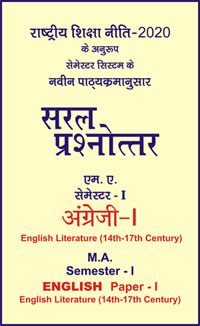
एम ए सेमेस्टर-1 - अंग्रेजी - प्रथम प्रश्नपत्र - अंग्रेजी साहित्य 14वीं-17वीं शताब्दी
सरल प्रश्नोत्तर समूह
मूल्य: Rs. 400