 i
i 





|
बी एड - एम एड >> बी.एड. सेमेस्टर-1 प्रश्नपत्र-I - फिलासफिकल पर्सपेक्टिव आफ एजुकेशन बी.एड. सेमेस्टर-1 प्रश्नपत्र-I - फिलासफिकल पर्सपेक्टिव आफ एजुकेशनसरल प्रश्नोत्तर समूह
|
|
|||||||

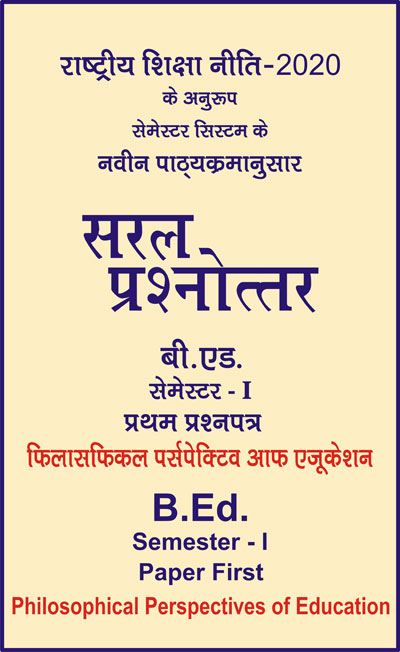

बी.एड. सेमेस्टर-1 प्रश्नपत्र-I - फिलासफिकल पर्सपेक्टिव आफ एजुकेशन (अंग्रेजी भाषा में)
Question- Describe Rousseau Education and classroom Practices.
Answer -
Self-Education
Thus, negative education is self-education. It is the education of sense organs and the body. This may be more possible in the playground rather than in the classroom. As Rousseau said, “We give too much importance to words. We produce by chattering education chatters only. If you are all the time teaching morals to the child, you will make him a fool. If your mind is always giving instructions to the child, then his mind will become useless. Whatever the child learns in the playground is four times more useful than what he learns in the classroom.”
Stages of Development: According to Rousseau, man’s development may be classified into the following four stages:
- Infancy, from birth to 5 years of age.
- Childhood, from 5 years to 12 years of age.
- Adolescence, from 12 years to 15 years of age.
- Youth, from 15 years to 20 years of age.
Rousseau has suggested suitable education in all these stages in his book Emile.
Objectives of Education:
In the opinion of Rousseau, education aimed at the natural development of the child’s inner faculties and powers. Education should help the child to remain alive. Life implies not merely the taking of breath but working. To live is to work, to develop and to properly utilise the various parts of the body, the sense organs and the various other powers of the body.
But the aims of education change at different stages of the child’s development, because at each stage something different needs stress. The following are the various aims of the education according to each level of the child's development :
1. Infancy : This stage begins at birth and continues up to five years of age. The chief objective during these five years is bodily development, the development and strengthening of every part of the body. It forms the basis of subsequent healthy development of the mind.
2. Childhood : This stage lasts from the fifth year to the twelfth, and it is the period of developing the child’s sense orgAnswer - This development is achieved through experience and observation.
3. Adolescence : As far as ‘Emile’ is concerned, Adolescence was believed to last from the twelfth to the fifteenth year. The child develops his body and his sense orgAnswer - During adolescence, the individual should be given knowledge of various kinds so that he is enabled to fulfil his needs.
4. Youth : The individual passes through his youth and he undergoes development of emotions and sentiments. Rousseau pointed out, "We have formed his body, his senses and intelligence, it remains to give him a heart".
Curriculum of Education -
It is possible to arrive at Rousseau’s concept of a curriculum from an analysis of the various stages of development described in his Emile.
1. Infancy : Rousseau was very critical of the contemporary curriculum laid down for the education of infants, because he stressed the fact that infants should be treated as infants and not as adults in the miniature. Rousseau stated, "The only habit the child should be allowed to contract is that of having no habits."
2. Childhood : Even in childhood, Rousseau objected to the use of any textbooks for education; because he wanted to keep Emile away from books of any kind up to the twelfth year. He thought it necessary to give the child a chance to learn everything through direct experience and observation. Hence, up to the childhood stage, no curriculum of any kind is required.
3. Adolescence : Having arrived at the appropriate level of bodily and sensory development, the child can now be exposed to teaching according to a formal curriculum consisting of education in natural science, language, mathematics, woodwork, music, painting, social life and some kind of professional training.
4. Youth : In the curriculum for youth, special stress has been laid on moral and religious education. But even moral education is to be derived through actual experience rather than through formal lectures. The youth derives many lessons from these stories. Apart from moral and religious education, Rousseau gave appropriate importance to education in bodily health, music and sex.
|
|||||
अन्य पुस्तकें
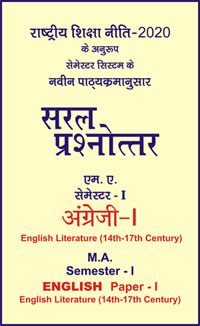
एम ए सेमेस्टर-1 - अंग्रेजी - प्रथम प्रश्नपत्र - अंग्रेजी साहित्य 14वीं-17वीं शताब्दी
सरल प्रश्नोत्तर समूह
मूल्य: Rs. 400