 i
i 





|
बी एड - एम एड >> बी.एड. सेमेस्टर-1 प्रश्नपत्र-I - फिलासफिकल पर्सपेक्टिव आफ एजुकेशन बी.एड. सेमेस्टर-1 प्रश्नपत्र-I - फिलासफिकल पर्सपेक्टिव आफ एजुकेशनसरल प्रश्नोत्तर समूह
|
|
|||||||

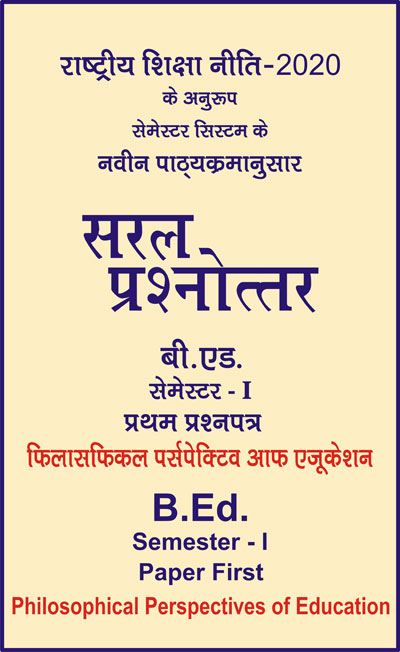

बी.एड. सेमेस्टर-1 प्रश्नपत्र-I - फिलासफिकल पर्सपेक्टिव आफ एजुकेशन (अंग्रेजी भाषा में)
Question- Describe the Principles of curriculum construction and Education method.
Answer -
Curriculum
Dewey believed that the educational process has two aspects: psychological and social.
(a) Psychological : The curriculum and the method of education should be determined by the child’s instincts and abilities. The child should be educated according to his interest and inclination.
(b) Social : All education has its beginnings in the individual’s participation in the social consciousness of the race. Hence, it is necessary to create an atmosphere in the school which will allow the child to take an ...
Principles of Curriculum Construction
Dewey has stressed the following four principles as underlying the formation of educational curricula:
1. Utility : The curriculum imposed on the child must have some utility, meaning thereby that the curriculum should be based on the child’s interests. The four kinds of interests are involved in this process—
(i) The desire to talk and exchange ideas,
(ii) Discovery of facts,
(iii) Creation, and
(iv) Artistic expression.
2. Flexibility : It is better for the curriculum to be flexible and not predetermined and rigid. It must be capable of accommodating the changes in the child’s interests and inclinations.
3. Experiential : The curriculum should be related to the child’s contemporary experiences, and these can be multiplied and reinforced by presenting different kinds of activities in the guise of problems which inspire the child to attempt a solution.
4. Close to Life : As far as possible, the curriculum should include only those subjects which can be related to the child’s pattern of life at the particular stage. This proximity to life can help in creating a distinctive unity in the knowledge imparted to him and thereby some harmony can be created in the teaching of history, geography, mathematics, and language, etc.
Educational Method
1. Learning by Doing : Dewey, himself a successful educational psychologist, has presented many novels and useful ideas on educational methods in his two books, ‘How We Think’ and ‘Interest and Efforts in Education’. The most well-known principle enunciated by him is the theory of learning by doing, in which the child learns best when he himself performs actions related to particular subjects. The child should be acquainted with facts while he is engaged in activity relating to those facts.
2. Integration of Subjects and Activities : Dewey is of the opinion that there should be integration between the child’s life, his activities, and the subjects. All subjects to be taught to the child should be arranged around his activities in such a manner that he acquires knowledge in the process of doing activities to which he is accustomed.
3. Self-Willed Activity : The next question that arises is that of designing the method of teaching according to the child’s interests. Dewey considers interest and efforts to be of supreme importance in the process of education. The educator must understand the child’s interest before organizing the activities which are useful for the child.
4. Project Method : Dewey’s ideas on educational methods later on led to the evolution of the project method in which the child was made to indulge in those activities which helped in the developmentof enthusiasm, self-confidence, self-reliance and originality.
5. Preparation in Collective Activities : In a democratic educational pattern, the child should be made to participate in collective activity which can help in evolving a cooperative and social spirit.
|
|||||
अन्य पुस्तकें
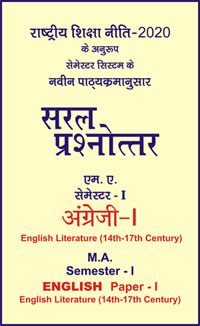
एम ए सेमेस्टर-1 - अंग्रेजी - प्रथम प्रश्नपत्र - अंग्रेजी साहित्य 14वीं-17वीं शताब्दी
सरल प्रश्नोत्तर समूह
मूल्य: Rs. 400