
 i
i 





|
बी एड - एम एड >> बी.एड. सेमेस्टर-1 प्रश्नपत्र-I - फिलासफिकल पर्सपेक्टिव आफ एजुकेशन बी.एड. सेमेस्टर-1 प्रश्नपत्र-I - फिलासफिकल पर्सपेक्टिव आफ एजुकेशनसरल प्रश्नोत्तर समूह
|
|
|||||||

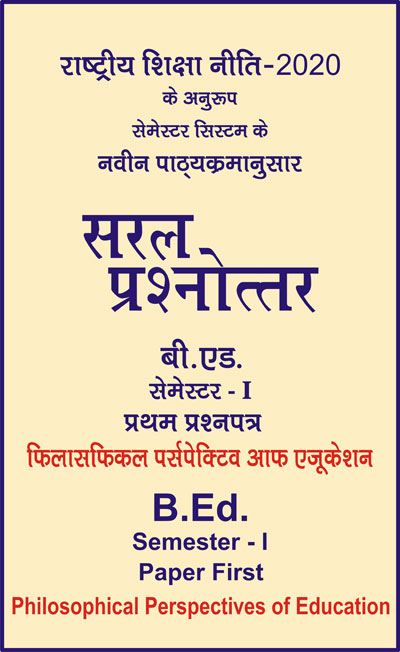

बी.एड. सेमेस्टर-1 प्रश्नपत्र-I - फिलासफिकल पर्सपेक्टिव आफ एजुकेशन (अंग्रेजी भाषा में)
Question- Explain his school organisation and Critism.
Answer -
School Organisation of Dewey
1. Experimental School : Dewey started his experimental school - The University Laboratory School, in 1896. He wanted that the training of scholars in school should be such as to enable them for a complete living in the social world of today. “The quest for the three goals represents the great contribution of Dewey to educational theory” -
(i) Scientific method.
(ii) Humanistic ethics.
(iii) Democratic theory.
2. Role of the Educator : Dewey considers the educator to be so important that he goes so far as to call him God’s representative on earth. In determining the educator’s own behaviour in the school, Dewey accepts democratic principles and educational psychology as suitable guides for shaping the educator’s conduct. In order to realise the values of equality and independence in the school, the educator should not treat himself as superior to the children. He must also consciously abstain from imposing his own ideas, interests, views and tendencies on the children. The educator must also try and engage the children in activities which compel them to think and reason out things for themselves.
3. Discipline : If the educator conducts himself on the lines suggested above, discipline in the school becomes easy. Difficulties arise only when discipline takes the form of an external force employed to restrain the child from expressing his natural desires. The traditional concept of discipline was severely criticised by Dewey. He argued that discipline depends not only upon the child’s own personality but also upon the social environment in which he is placed. True discipline takes the form of social control and this is evolved when the child engages in collective activity in the school. It is, therefore, desirable to create an atmosphere in the school which encourages the children to live in mutual harmony and cooperation. Discipline and regularity of habit can be induced in children by making them act in consonance with each other in trying to achieve a single objective.
4. Extra-Curricular Activities : Participation in social activity is an essential part of educational training, in Dewey’s opinion. The school itself is a rudimentary form of society. If the child is encouraged to take part in all collective activities in the school, he will not only be able to maintain discipline in the school, but he will also be simultaneously trained for many activities he must perform in social life. Thus, he will also learn to lead a disciplined life as an adult.
Criticism
Although Dewey’s views on educational principles were enthusiastically received, they were also subjected to criticism on the following grounds:
1. Difficulties of not accepting truth to be permanent : Pragmatist philosophy does not treat truth as permanent and objective. Instead, as Dewey explains, all truth is relative to time and space. No philosophy is always true or correct. It has its utility only in a particular set of circumstances. And utility is the final criterion of truth.
2. Materialistic Bias : Pragmatism was born out of reaction to idealism, and consequently, it manifests a distinctly materialistic bias, in contradiction of the spiritual bias of idealist philosophy.
3. Absence of any Aim of Education : The achievement of democratic ideals through education seems to be implicit in Dewey’s educational philosophy, because he rarely ascribes a particular aim to education in explicit terms.
4. Excessive Emphasis upon Individual Differences : Modern educational psychology accepts in principle that the curriculum of education must take into account the individual differences of children and that children must be educated according to their individual and unique interests and inclinations both in respect of curriculum and also of the method of teaching. While in theory this is quite acceptable, any attempts to apply it in practice lead to immediate complications.
5. Limitations in Learning Through Doing : There is no doubt that the child should learn by actually doing things, as Dewey suggested, yet the theory has its limitations. Many facts known to an individual are acquired from another person. It is almost impossible for one individual to experience every fact known to him.
|
|||||
अन्य पुस्तकें
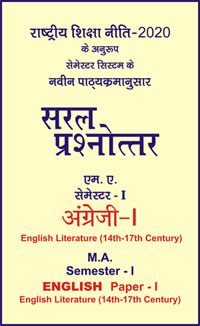
एम ए सेमेस्टर-1 - अंग्रेजी - प्रथम प्रश्नपत्र - अंग्रेजी साहित्य 14वीं-17वीं शताब्दी
सरल प्रश्नोत्तर समूह
मूल्य: Rs. 400