 i
i 





|
बी एड - एम एड >> बी.एड. सेमेस्टर-1 प्रश्नपत्र-I - फिलासफिकल पर्सपेक्टिव आफ एजुकेशन बी.एड. सेमेस्टर-1 प्रश्नपत्र-I - फिलासफिकल पर्सपेक्टिव आफ एजुकेशनसरल प्रश्नोत्तर समूह
|
|
|||||||

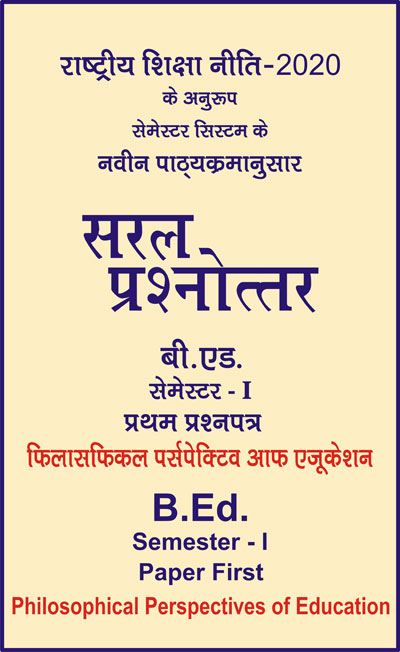

बी.एड. सेमेस्टर-1 प्रश्नपत्र-I - फिलासफिकल पर्सपेक्टिव आफ एजुकेशन (अंग्रेजी भाषा में)
OBJECTIVE TYPE QUESTIONS
Unit - IV
Indian and Western Educational Thinkers
-
Who said, “Nature wants that the child should remain a child”?
(a) Rousseau
(b) Dewey
(c) Pestalozzi
(d) Russell -
Who said, “We give too much importance to words”?
(a) Rousseau
(b) Dewey
(c) Pestalozzi
(d) Russell -
Who said, “We need first of all general education of head, heart, and hand”?
(a) Rousseau
(b) Pestalozzi
(c) John Dewey
(d) Bertrand Russell -
Who said, “I want to teach beggars to life like men”?
(a) Rousseau
(b) Pestalozzi
(c) John Dewey
(d) Bertrand Russell -
Whose philosophy is known as experimentalism?
(a) Rousseau
(b) Pestalozzi
(c) John Dewey
(d) Bertrand Russell -
Who said, “All that is human is learned”?
(a) John Dewey
(b) J.J. Rousseau
(c) William McDougall
(d) Herbart Spencer -
Who said, “Nature’s discipline is not even a word and a blow, and the blow part but the blow without a word”?
(a) T.H. Huxley
(b) John Dewey
(c) Herbart Spencer
(d) R.N. Tagore -
Who said, “Teaching while walking is the best method of education”?
(a) R.N. Tagore
(b) J.J. Rousseau
(c) M.K. Gandhi
(d) S. Radhakrishnan -
Who said, “Our true education is possible only in the forest”?
(a) R.N. Tagore
(b) M.K. Gandhi
(c) Herbart Spencer
(d) J.J. Rousseau -
Who wrote the book ‘Emile’?
(a) J.J. Rousseau
(b) Herbart Spencer
(c) John Lock
(d) R.N. Tagore -
Who wrote the essay “How to make our ideas clear”?
(a) Charles Pierce
(b) William James
(c) John Dewey
(d) F.C.S. Sehiller -
Who was called as a pemmentalist?
(a) Charles Pierce
(b) William James
(c) John Dewey
(d) F.C.S. Sehiller -
Who propounded Humanistic Pragmatism?
(a) Charles Pierce
(b) William James
(c) August Comte
(d) John Dewey -
Who said, “Our business not to know all things but those which concern out conduct”?
(a) John Locke
(b) Bentham
(c) John Dewey
(d) F.C.S. Sehiller -
Who propounded Instrumentalism?
(a) John Locke
(b) Bentham
(c) John Dewey
(d) F.C.S. Sehiller -
Who wrote the Republic?
(a) Socrates
(b) Plato
(c) Aristotle
(d) Comenius -
Who said knowledge is virtue?
(a) Socrates
(b) Plato
(c) Aristotle
(d) Comenius -
What was the philosophy of Sankaracharya?
(a) Dvaita
(b) Advaita
(c) Visistadvaita
(d) Dwaitadvaita -
Who is called Jagat Guru?
(a) Sankaracharya
(b) Ramanuja
(c) Vallabha
(d) Madhva -
Who was the first idealist philosopher?
(a) Socrates
(b) Plato
(c) Aristotle
(d) Epicurus -
When did Gandhi evolve the principle of Basic Education?
(a) 1932
(b) 1937
(c) 1940
(d) 1947 -
Who was Chairman of Wardha Committee?
(a) M.K. Gandhi
(b) B.G. Kher
(c) Zakir Hussain
(d) A.K. Azad -
What was the full name of Gijju Bhai?
(a) Girija Bhai
(b) Girija Shankar
(c) Girija Shankar Bedheka
(d) Girija Shankar Bhagwanji Bedheka -
What is the nation of ‘The World of Child’?
(a) A different world
(b) Like the world of adult
(c) Full of wordly problems
(d) Full of adult experience -
Which one of the following was not written by Gijju Bhai?
(a) School and Society
(b) Diwa Swapna
(c) Moorkh Brahma
(d) Bhut Ka Bhai -
Who is the proponent of logical intellectualism?
(a) Socrates
(b) Plato
(c) Kant
(d) Voltaire -
Which teaching method was developed by Pestalozzi?
(a) Logic method
(b) Exercise method
(c) Exercise and repetition method
(d) Play-way method -
Who has developed the instructional method of teaching?
(a) Plato
(b) Herbart
(c) Froebel
(d) Aristotle -
According to Thales, the basic element of this world is:
(a) Water
(b) Fire
(c) Air
(d) Sky (Ether) -
According to Heraclites, the basic substance of the world is:
(a) Water
(b) Air
(c) Fire
(d) Sky -
Who has constructed the project method?
(a) Dewey
(b) Kilpatric
(c) William James
(d) Sanders Pierce -
Which text influenced Gandhiji the most?
(a) Vedas
(b) Upanishads
(c) Gita
(d) Ramayana -
According to Gandhiji, what is the real form of bhakti?
(a) Worship
(b) Rituals
(c) Satsang
(d) Service to humanity -
At what place has Gandhiji placed non-violence in his Ekadash Vrita?
(a) First
(b) Second
(c) Third
(d) Fifth -
When did Gandhiji present his National Basic Education Plan?
(a) 1937
(b) 1938
(c) 1947
(d) 1948 -
In which form did Sri Aurobindo accept Brahma?
(a) Shunya
(b) Sat
(c) Sat + chit
(d) Sat + chit + anand -
In which form did Sri Aurobindo consider the spirit or soul?
(a) Part of Brahma
(b) Sat
(c) Chit
(d) Chit + anand -
Who is the creator of this universe, according to Sri Aurobindo?
(a) Brahma
(b) Ishwar
(c) Soul
(d) Thought -
Where is the Sri Aurobindo Antarrashtriya Shiksha Kendra located?
(a) Chennai
(b) Pondicherry
(c) Shantiniketan
(d) Shantikunj -
In which field is Gurudev the most famous?
(a) Education
(b) Literature
(c) Religion
(d) Politics -
What influenced Gurudev Tagore the most?
(a) Vedas
(b) Upanishads
(c) Gita
(d) Puranas -
What is the present name of the educational institution established by Tagore?
(a) Shantiniketan
(b) Sriniketan
(c) Vishvabharati
(d) None of these -
In which form did Tagore accept religion?
(a) Worship
(b) Rituals
(c) Human service
(d) Devotion to God -
How many are the basic elements of this universe according to Vivekananda?
(a) One
(b) Two
(c) Five
(d) Several -
What should be the ultimate aim of education, according to Vivekananda?
(a) Physical development
(b) Moral development
(c) Spiritual development
(d) Vocational development -
Gijju Bhai was born in which state?
(a) Maharashtra
(b) Gujarat
(c) Rajasthan
(d) Bihar -
To which stage is the educational thought of Gijju Bhai limited?
(a) Infant education
(b) Child education
(c) Adolescent education
(d) All education -
In which style has Gijju Bhai written his book Diwa Swapna?
(a) Story
(b) Drama
(c) Question-Answer -
(d) Description -
In which form has Gijju Bhai stressed developing infant schools?
(a) House
(b) Garden
(c) Temple
(d) Beautiful forest -
In which country was Montessori born?
(a) England
(b) America
(c) Italy
(d) France -
How did Montessori start her career?
(a) Teacher
(b) Doctor
(c) Clerk
(d) Advocate -
Montessori was assigned the duty of looking after the treatment of which of the following?
(a) Children
(b) Men
(c) Women
(d) Handicapped children -
On which level of education has Montessori expressed her views?
(a) Only infant
(b) Infant and child
(c) Only children
(d) All levels -
In which country was Froebel born?
(a) England
(b) Germany
(c) France
(d) America -
What should be the foremost aim of education, according to Froebel?
(a) Physical development
(b) Training of sense organs
(c) Mental development
(d) Unity of self -
Which system of education was propounded by Mahatma Gandhi?
(a) Teaching by activities
(b) Teaching through music
(c) Teaching through listening, meditation etc.
(d) All of these -
Idealism basically rests on the ideas of:
(a) Aristotle
(b) Dewey
(c) Rousseau
(d) Plato -
Realism basically rests on the ideas of:
(a) Aristotle
(b) Dewey
(c) Rousseau
(d) Plato -
Pragmatism basically rests on the ideas of:
(a) Aristotle
(b) Dewey
(c) Rousseau
(d) Plato -
Naturalism basically rests on the ideas of:
(a) Aristotle
(b) Dewey
(c) Rousseau
(d) Plato -
The following definition of education Dewey liked best:
(a) Product
(b) Acquisition of knowledge
(c) Preparation of life
(d) Reconstruction of experience -
From the following which one is not among the major exponents of Perennialism?
(a) Adler
(b) Hutchins
(c) John Dewey
(d) Bantock -
Gandhiji believes in the absolute oneness:
(a) God
(b) World
(c) Country
(d) Culture -
Gandhiji made a dramatic bid for temple entry rights for untouchables in the year:
(a) 1920
(b) 1930
(c) 1940
(d) 1950 -
After Gandhiji’s assassination, several Brahman homes were set on fire in:
(a) West Bengal
(b) Gujarat
(c) Maharashtra
(d) Punjab -
Gandhiji believes in the essential of man and for that matter of all that life:
(a) Certainty
(b) Unity
(c) Uncertainty
(d) All of the above -
Zeal and temperament to perform the stupendous task of educating children in the framework of:
(a) Tagore’s philosophy
(b) Gandhiji’s philosophy
(c) Dr. De Young’s philosophy
(d) None of the above -
Gandhiji searched for truth as:
(a) An egoist
(b) For power
(c) An humanist
(d) As communist -
Traditionally untouchables were not allowed to:
(a) Pass-through certain streets
(b) Enter temples
(c) Enter certain parks
(d) All of the above -
At the bottom of the social ladder is a group of castes officially known as the:
(a) Upper castes
(b) Forward castes
(c) Scheduled castes
(d) Backward castes -
The lowest and the most depressed are the:
(a) Scheduled caste
(b) Forward
(c) Backward
(d) Untouchables -
Gandhiji was a philosopher in the sense that he has certain:
(a) Life views
(b) Systematic approach
(c) Belief
(d) All of the above -
Whose remarks are restricted to learning from direct experience and to learning from the teacher and excludes learning through self-study and general reading? It is bound to be limited and rate given by:
(a) Dr. E. A. Pires
(b) Fichte
(c) Dewey
(d) Dr. H. Bhabha -
Mahatma Gandhi was:
(a) Experimenter all his life
(b) Leader all his life
(c) Philosopher all his life
(d) Can't say -
Gandhiji is more known in the domain of:
(a) Politics
(b) In the field of education
(c) Social reform
(d) None of the above -
A prophet of its spiritual regeneration’ was:
(a) Dr. De Young’s
(b) M.K. Gandhi
(c) R.N. Tagore
(d) Ficnet -
Gandhiji’s opinion about God is/are:
(a) Light
(b) Truth
(c) Life
(d) All of the above -
My Experiment with Truth is written by:
(a) Kabir
(b) Mahatma Gandhi
(c) Jawahar Lal Nehru
(d) Ramanand -
Who demonstrated the value of education in the vitalization of Indian society?
(a) S. Dayanand
(b) Rabindranath Tagore
(c) S. Vivekanand
(d) Raja Ram Mohan Roy -
Rabindranath Tagore’s ideas of education is that:
(a) Education for all
(b) Education for fullness
(c) Education for liberation
(d) Education for Man-Making -
“The pioneer educational efforts of the Christian mission impressed” to:
(a) Rabindranath Tagore
(b) Raja Ram Mohan Roy
(c) Both a & b
(d) None of these -
“If you want to find the value of any single fact or experience. You can never do so by dealing with the fact in isolation.” Who said it:
(a) Hegal
(b) Kant
(c) Fichte
(d) None of the above -
Who advocated social service in all forms to be the real expression of religion?
(a) Swami Vivekanand
(b) Raja Ram Mohan Roy
(c) Swami Dayanand Saraswati
(d) Kabir -
Mahatma Gandhi’s Basic Education Scheme was characterized by:
(a) Strict discipline and punishment for wrongs
(b) Opposition to strict control and punishment
(c) Education of children through sense training
(d) Strict supervision and control of activities -
Rabindranath Tagore lived in:
(a) Late twentieth Century
(b) Early twentieth Century
(c) Early Nineteenth Century
(d) Late Nineteenth Century -
The Negative Education suggested by Rousseau asserts that:
(a) There should be no compulsion for children to attend school
(b) School education should enable children to desist during negative things
(c) Knowledge should not be based on books and symbols but on nature
(d) Too much work and rules in schools should be modified -
In Gandhi’s opinion God is the ultimate:
(a) Reality
(b) Objective
(c) Religion
(d) Not exist -
Education should aim at man making this philosophy is given by:
(a) S. Vivekanand
(b) Yajnavalaka
(c) Shankaracharya
(d) Kannad -
Maria Montessori in her approach to childhood, bases her method of education on:
(a) Humanism
(b) Naturalism
(c) Idealism
(d) Existentialism -
According to John Dewey the Education is basically:
(a) Getting to do things
(b) Getting knowledge
(c) Learning to do by doing
(d) Preparation of life -
Generally essentialism stresses upon:
(a) Change
(b) Innovation
(c) Reduced knowledge
(d) Mental discipline -
Who originated the concept of reconstruction?
(a) Karl Marx
(b) Mortimer Adler
(c) John Dewey
(d) Hegel -
Which one of the following emphasized that education should be a social process?
(a) Rousseau
(b) Dewey
(c) Pestalozzi
(d) Frobel -
Which system of education was propounded by Mahatma Gandhi?
(a) Teaching through listening, meditation etc.
(b) Teaching through music
(c) Teaching by activities
(d) All of these -
Who said, “Reverse the usual practice and you will almost always do right”?
(a) Plato
(b) Dewey
(c) Rousseau
(d) Mahatma Gandhi -
“Human institutions are one mass of folly and contradiction.” Whose statement is this?
(a) Dewey
(b) Rousseau
(c) Bernard Shaw
(d) Ravinder Nath Tagore -
Who was the nineteenth-century founder of Existentialism?
(a) Hegel
(b) Rousseau
(c) D.J. O’Connor
(d) Soren Kierkegaard -
Who was a twentieth-century Existentialist?
(a) Hegel
(b) D.J. O’Connor
(c) Jean Paul Sartre
(d) Soren Kierkegaard -
Who emphasized that education should be a social process?
(a) Dewey
(b) Rousseau
(c) Pestalozzi
(d) Vivekananda -
Under whose leadership was the University at Pondicherry founded?
(a) Tagore
(b) Gandhi
(c) Sri Aurobindo
(d) Vivekananda -
On whose philosophy is the current primary education in India based?
(a) Tagore
(b) Gandhi
(c) Sri Aurobindo
(d) Vivekananda -
Material and spiritual knowledge is already present in man covered by a ‘curtain of ignorance’—who said this?
(a) Plato
(b) Tagore
(c) Gandhi
(d) Vivekananda -
As an educationist, Gandhiji was:
(a) An Idealist
(b) A naturalist
(c) A Pragmatist
(d) Naturalist, an Idealist, and a Pragmatist all together -
The ultimate aim of education, according to Gandhiji, was to help individuals to be:
(a) Gainfully employed in life
(b) Peaceful and happy in life
(c) Able to grow into a divine human being by realizing Godliness
(d) Able to acquire as much as possible from the ocean of knowledge -
What did Gandhiji’s philosophy of education stress as the aim of education?
(a) A synthesis of individual and social aims
(b) Individual aims
(c) Cultural aims
(d) Social aims -
Rabindra Nath Tagore was a Naturalist because he said about children that:
(a) They should be educated for national integration
(b) They should be made to develop into complete human beings
(c) They should be acquainted with the ideals and values of national culture
(d) They should be given full freedom to live in a natural environment and learn by doing -
Tagore was an Idealist because he emphasized:
(a) Vocational education
(b) Rigid control and discipline in schools
(c) Religious education in a formal manner
(d) Moral and spiritual development of the child -
Which of the following is the contribution of Rousseau to education?
(a) Education for Freedom
(b) Education for Nationalism
(c) Education for Democracy
(d) Education for State control -
Which of the following represents the fascist ideal of education?
(a) Education for Freedom
(b) Education for Nationalism
(c) Education for Democracy
(d) Education for State control -
Who among the following has propounded idealism in education?
(a) Plato
(b) Russell
(c) Rousseau
(d) John Dewey
|
|||||
अन्य पुस्तकें
एम ए सेमेस्टर-1 - अंग्रेजी - प्रथम प्रश्नपत्र - अंग्रेजी साहित्य 14वीं-17वीं शताब्दी
सरल प्रश्नोत्तर समूह
मूल्य: Rs. 400