 i
i 





|
बी एड - एम एड >> बी.एड. सेमेस्टर-1 प्रश्नपत्र-I - फिलासफिकल पर्सपेक्टिव आफ एजुकेशन बी.एड. सेमेस्टर-1 प्रश्नपत्र-I - फिलासफिकल पर्सपेक्टिव आफ एजुकेशनसरल प्रश्नोत्तर समूह
|
|
|||||||

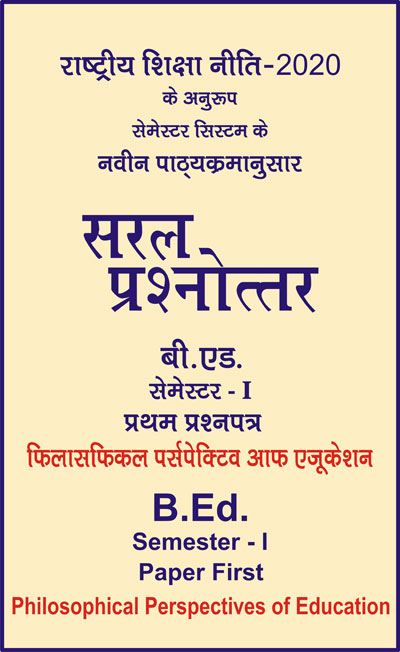

बी.एड. सेमेस्टर-1 प्रश्नपत्र-I - फिलासफिकल पर्सपेक्टिव आफ एजुकेशन (अंग्रेजी भाषा में)
OBJECTIVE TYPE QUESTIONS
Indian Philosophy and Schools of Philosophy-
What is the ultimate reality according to moralistic idealism?
(a) Matter
(b) Nature
(c) Soul
(d) God -
What type of supporter was Erasmus to realism?
(a) Humanist
(b) Sociologist
(c) Perceptive
(d) None -
What is the ultimate reality according to realism?
(a) Nature
(b) Matter
(c) Soul
(d) God -
What is the ultimate reality according to pragmatists?
(a) Matter
(b) Soul
(c) God
(d) Real experience -
On which basis of education have the pragmatists laid the most emphasis?
(a) Philosophical
(b) Social
(c) Psychological
(d) Political -
On what type of discipline do the pragmatists lay emphasis?
(a) Repressionistic
(b) Impressionistic
(c) Emancipationistic
(d) Self-discipline -
Epistemology deals with the concept of:
(a) Reality
(b) Values
(c) Knowledge
(d) Reasoning -
The main school of philosophy is the:
(a) Pragmatism
(b) Realism/Idealism
(c) Naturalism
(d) All the above -
On what depends the values of an educational experience in the eyes of the idealist?
(a) Whether or not the pupil has been properly motivated
(b) Whether or not it preserves accepted institutions
(c) The extent to which it satisfies pupil desires
(d) The manner in which it affects future experience -
Which educational activity is most desirable to the pragmatist?
(a) Approximates the goals which educational scientists have set up
(b) Results from the indiscrimination of the pupil in democratic theory
(c) That is beneficial effect upon the future experiences of the pupil
(d) That characterizes by spontaneous, active, continuously pleasurable and practical for the pupil -
Who was the supporter of Naturalism in Education?
(a) Frobel
(b) Armstrong
(c) John Locke
(d) Rousseau -
Who raised the slogan “Back to Nature”?
(a) Realism
(b) Pragmatism
(c) Naturalism
(d) Existentialism -
Which statement is not correct about Naturalism?
(a) A reaction against the degenerated humanism of the Renaissance period
(b) A reaction against the degenerated humanism of the Renaissance period
(c) A reaction against sophistication, artificiality and paraphernalia in education
(d) A reaction against a mere study of books and linguistic forms -
Who said, “Reverse the usual practice and you will almost always do right?”
(a) Mahatma Gandhi
(b) Rousseau
(c) Dewey
(d) Plato -
“Human institutions are one mass of folly and contradiction.” Whose statement is this?
(a) Bernard Shaw
(b) Rousseau
(c) Dewey
(d) Ravinder Nath Tagore -
According to which school of philosophy of education, exaltation of individual’s personality is a function of education?
(a) Pragmatism
(b) Idealism
(c) Marxism
(d) (b) and (c) both -
Which is not Naturalism’s aim of Education?
(a) Education is the notion of man’s evolution from lower forms of life
(b) To equip the individual or the nation for the struggle for existence so as to ensure survival
(c) To help the pupils to learn to be in harmony with and well-adapted to their surroundings
(d) To inculcate ethical and moral values in the pupils -
Which school held the view, “God makes all things good; man meddles with and they become evil?”
(a) Marxism
(b) Existentialism
(c) Naturalism
(d) Pragmatism -
Which school maintained self-expression with the accompanying cries of “no interference”, “no restraints”?
(a) Extreme form of Naturalism
(b) Most widely accepted form of Naturalism
(c) Truest form of Naturalism
(d) Most valid form of Naturalism -
Which school maintained : “Natural impulses of the child are of great importance and are good in themselves?”
(a) Biological Naturalism
(b) Mechanical Naturalism
(c) Naturalism of physical science
(d) Romantic Naturalism -
What is the goal of education according to Idealism?
(a) Perfect adaptation to the environment
(b) Realisation of moral values
(c) Satisfaction of human wants
(d) Cultivation of dynamic, adaptable mind which will be resourceful and enterprising in all situations -
The aim of education according to the Existentialists is :
(a) Humanitarian and humanist self-realization
(b) Adaptation to practical life
(c) Objective knowledge
(d) A good understanding of the world outside -
Naturalist’s conception of man is :
(a) Man’s very essence of being is his spiritual nature
(b) It is spirit rather than animality that is most truly man
(c) There exists in the nature of things a perfect pattern of each individual
(d) Nature would have them children before they are men -
Which philosophy of education considers psychology as an incomplete study of and an inadequate basis of educational theory?
(a) Realism
(b) Pragmatism
(c) Idealism
(d) Naturalism -
Which among the following does not fit into the scheme of educational goals of the Idealists?
(a) Care of body
(b) Moral values
(c) Skills
(d) Self-expression -
Religious education is strongly advocated by :
(a) Pragmatists
(b) Idealists
(c) Realist
(d) Existentialists -
Which of the following is said about the idealists?
(a) They are content with “briars”
(b) They like “roses”
(c) They are satisfied neither with “briars” nor with “roses”
(d) They want “roses” and “briars” both -
Which school of philosophy of education advocated Project method of teaching?
(a) Realism
(b) Pragmatism
(c) Idealism
(d) Naturalism -
Play way method of teaching has been emphasized in the scheme of the education of:
(a) Naturalists
(b) Realists
(c) Pragmatists
(d) Existentialists -
Which is the most widely accepted method of education, according to the pragmatists?
(a) Lecturing by the teacher
(b) Leaving the child free to learn
(c) Learning by doing
(d) Heuristic method -
The pragmatists are against:
(a) The external examinations
(b) The specialist teachers
(c) Breakdown of knowledge into separate subjects
(d) Eternal spiritual values -
Pragmatism has a greater sense of responsibility than Naturalism with regard to moral training because:
(a) The free activity which pragmatic-system of education entails does not mean licence; rather it means a guided activity
(b) They emphasize teaching of values.
(c) They consider education, basically, a social process
(d) They do not want the teacher to abdicate from the scene -
Which of the following claims of the pragmatists is not acceptable?
(a) The free activity of the pupil is likely to result in permanent attitudes of initiative and independence and moral discipline
(b) Training in citizenship is possible through school and community activities
(c) Training in character through school’s co-curricular activities is possible
(d) Child’s own experience is valuable for adequate development of child’s personality -
Project method of teaching is an outstanding contribution of:
(a) Realism
(b) Pragmatism
(c) Naturalism
(d) Idealism -
Education, according to the Pragmatist is :
(a) Wholly pupil-oriented
(b) Wholly society-oriented
(c) Wholly purposive
(d) Wholly interdisciplinary -
Who among the following is not a follower of Pragmatic Philosophy?
(a) William James
(b) Peshtalozzi
(c) John Dewey
(d) Kilpatrick -
What is not associated with Pragmatism?
(a) Purposive education
(b) Experience-based education
(c) Freedom-based education
(d) Education for self-realization -
Who emphasised realization of Truth, Beauty and Goodness as the aims of education?
(a) Idealists
(b) Pragmatists
(c) Realists
(d) Naturalists -
Which statement about truth is not correct according to the philosophy of Pragmatism?
(a) It is made by man
(b) It is ever changing
(c) It is eternal
(d) It is what emerges to be true in actual practice -
In whose methodology of teaching “Experimentation” is the key-note of?
(a) Idealism
(b) Existentialism
(c) Realism
(d) Pragmatism -
The term “progressive education” related to :
(a) Realism
(b) Pragmatism
(c) Idealism
(d) Existentialism -
Who said, “No fixed aims of education and no values in advance”?
(a) Progressive educators
(b) Idealists
(c) Realists
(d) Marxists -
Which school of philosophy of education stresses the direct study of men and things through tours and travels?
(a) Social realism
(b) Idealism
(c) Existentialism
(d) Marxism -
Which school believes that all knowledge comes through the senses?
(a) Idealism
(b) Sense Realism
(c) Pragmatism
(d) Existentialism -
Which school raised the slogan “Things as they are and as they are likely to be encountered in life rather than words?”
(a) Pragmatist
(b) Realists
(c) Idealists
(d) Existentialists -
As Huxley pleaded for the introduction of “a complete and thorough scientific culture” into schools, he is claimed to be :
(a) An Idealist
(b) A Realist
(c) A Pragmatist
(d) A Naturalist -
Realism in education was born out of :
(a) The enthusiasm of the Renaissance
(b) The great religious movement of the 17th century
(c) A cleavage between the work of the schools and the life of the world outside that occurred during the 19th century
(d) The degeneration of humanism after Renaissance -
Which of the following is not criticised by realism in education?
(a) Teachers denying the value of school co-curricular activities
(b) Pupils cramming for knowledge from books for reproducing in examination
(c) Organizing schools in a way that is conducive to practical training in citizenship
(d) Teaching which drifts away from life of the child -
In the light of relevant past events, contemporary events and their understanding should find a place in the teaching of history. Who maintained this principle?
(a) Naturalists
(b) Idealists
(c) Realists
(d) Marxists -
The most important thing to keep in mind for a teacher according to Realism in education is :
(a) The method of teaching
(b) The value and significance of what is taught
(c) The nature of the child
(d) Organization of the content to be taught -
Which school of philosophy very strongly advocates that education should be vocational in character?
(a) Existentialism
(b) Naturalism
(c) Realism
(d) Pragmatism -
Which is not an aspect of mind according to the Realists’ theory of knowing?
(a) Awareness
(b) Consciousness
(c) Behaviour
(d) Processing of awareness -
Who believe that “Objects have a reality independent of mental phenomena”?
(a) Idealists
(b) Realists
(c) Naturalists
(d) Existentialists -
Marxist educational philosophy is closer to :
(a) Idealism
(b) Realism
(c) Naturalism
(d) Pragmatism -
Which among the following statements is not a characteristic of Marxism?
(a) It presupposes a reality independent of man’s mind
(b) Its educational philosophy is essentially materialistic
(c) Its major objective is the development of child’s personality
(d) It asserts that physical environment can definitely change the nature of the child -
Which school of philosophy of education regrets dualism between cultural, and vocational curriculum?
(a) Marxism
(b) Idealism
(c) Existentialism
(d) Naturalism -
According to which educational philosophy, socially useful labour must form the central pivot of the entire school?
(a) Idealism
(b) Marxism
(c) Existentialism
(d) Naturalism -
Which of the following has been asserted about schools by Marxist educational philosophy?
(a) They should stand above politics
(b) They should disinterestedly serve society as a whole
(c) They should function as deliberate instruments of state policy
(d) They should not be mere weapons in the hands of the ruling class -
Which of the following characteristics is common to Pragmatism, Naturalism and Existentialism?
(a) Emphasis on spiritual aims of education
(b) Emphasis on the individual
(c) Emphasis on physical environment
(d) Emphasis on value education -
Whose is the ultimate concern - "What is existence"?
(a) Idealists only
(b) Realists only
(c) Existentialists and Idealists both
(d) Existentialists only -
Which of the following philosophies held that ‘Men in the world feel lonely and anxious, being unsure of their meaning and fearful of their annihilation’?
(a) Existentialism
(b) Idealism
(c) Marxism
(d) Pragmatism -
According to Existentialists, the essence of existence means :
(a) Unity with the ultimate reality
(b) Spiritual good and happiness
(c) Tensions and contradictions which condition loneliness and anxiety
(d) Continuous growth and development -
Who was the nineteenth century founder of Existentialism?
(a) Hegel
(b) Soren Kierkegaard
(c) Rousseau
(d) D.J. O’Connor -
Who was twentieth century Existentialist?
(a) Soren Kierkegaard
(b) D.J. O’Connor
(c) Jean Paul Sartre
(d) Hegel -
According to which philosophy of education, childhood is something desirable for its own sake and children should be children?
(a) Idealism
(b) Pragmatism
(c) Naturalism
(d) Realism -
In all walks of life reforms are necessary is focused in:
(a) Progressivism
(b) Reconstructionism
(c) Essentialism
(d) Perennialism -
Generally life is the continuous changing process that is the base of education philosophy:
(a) Progressivism
(b) Reconstructionism
(c) Essentialism
(d) Perennialism -
Which philosophy of education basically focused on useful culture and skills?
(a) Progressivism
(b) Reconstructionism
(c) Essentialism
(d) Perennialism -
Which philosophy of education emphasizes everlasting reality?
(a) Progressivism
(b) Reconstructionism
(c) Essentialism
(d) Perennialism -
The Republic which outlines a complete and remarkable plan of education is based on:
(a) Idealism
(b) Existentialism
(c) Humanism
(d) Naturalism -
Idealism in education asserts that:
(a) We would come to know the world as it really exists through education.
(b) Each learning mind would have to build up its own idea of world
(c) There should be no emphasis on the inner feelings of the individual but on copying the world
(d) We cannot accept any knowledge as valid without antecedent sense impressions -
Realism was basically a reaction to the narrowness of:
(a) Liberals
(b) Religious reformers
(c) Religion
(d) Idealism -
The term pragmatism is also known as:
(a) Realism
(b) Progressivism
(c) Humanism
(d) Idealism -
Realism basically concerns with the reality of:
(a) World
(b) Objects
(c) Universe
(d) Things -
Pragmatism basically concerns with change as a:
(a) Concern
(b) Fragment
(c) Reality
(d) Option -
Who introduces pragmatism?
(a) Charles Darwin
(b) William James
(c) John Dewey
(d) Charl’s S. Peres -
The great method of teaching by Naturalists is basically:
(a) Study tours
(b) Roleplaying
(c) Play-way
(d) Discussion -
From the following which school calls the classroom unnecessary?
(a) Marxism
(b) Naturalism
(c) Pragmatism
(d) Idealism -
Which is not a form of naturalism among the following?
(a) Naturalism of physical science
(b) Biological Naturalism
(c) Mechanical Naturalism
(d) Scientific Naturalism -
Who among the following propounded socialism in education?
(a) Stalin
(b) Sartre
(c) Dewey
(d) Russell -
From the following which school said, “Men are devoured by our towns”:
(a) Naturalism of Rousseau
(b) Realism
(c) Pragmatism of Dewey
(d) Idealism of Plato -
Wider use of educational technology is mainly justified by:
(a) Idealists
(b) Pragmatists
(c) Existentialists
(d) Realists -
Perennialism is basically an educational philosophy of:
(a) Old and present values
(b) Future values
(c) Present values
(d) Old values -
From the following who says “Human nature remains the same everywhere hence education should be same for everyone”:
(a) Essentialism
(b) Progressivism
(c) Reconstruction
(d) Perennialism -
Basically the term pragmatism derives its origin from:
(a) English
(b) Spanish
(c) Latin
(d) Greek -
Etymological definition of a word basically shows its derivation from:
(a) Arabic
(b) Persian
(c) Greek/ Latin
(d) English -
According to naturalism the main aim of education is:
(a) Moral sense
(b) Universal education
(c) Self-expression
(d) Self-realization -
In education who was the supporter of Naturalism:
(a) Armstrong
(b) John Locke
(c) Rousseau
(d) Froebel -
From the following which one of the education systems supports scientific progress?
(a) Naturalistic education
(b) Realistic education
(c) Idealistic education
(d) None of the above -
On what depends the values of an educational experience in the eyes of the idealist?
(a) The extent to which it satisfies pupil desires
(b) The manner in which it affects future experience
(c) Whether or not it preserves accepted institutions
(d) Whether or not the pupil has been properly motivated -
Which educational activity is most desirable to the pragmatist?
(a) That is beneficial effect upon the future experiences of the pupil
(b) Approximates the goals which educational scientists have set up
(c) Results from the in discrimination of the pupil in democratic theory
(d) That characterizes by spontaneous, active, continuously pleasurable and practical for the pupil -
Who was the supporter of Naturalism in Education?
(a) Frobel
(b) Rousseau
(c) Armstrong
(d) John Locke -
Which statement is not correct about Naturalism?
(a) A reaction against a mere study of books and linguistic forms.
(b) A reaction against the degenerated humanism of the Renaissance period
(c) A reaction against sophistication, artificiality and paraphernalia in education
(d) None of these -
According to which school of philosophy of education, exaltation of individual's personality is a function of education?
(a) Marxism
(b) Idealism
(c) Idealism and Marxism both
(d) Pragmatism -
Which school held the view, "God makes all things good; man meddles with and they become evil"?
(a) Marxism
(b) Naturalism
(c) Pragmatism
(d) Existentialism -
Which school maintained self-expression with the accompanying cries of "no interference", "no restraints"?
(a) Truest form of Naturalism
(b) Extreme form of Naturalism
(c) Most valid form of Naturalism
(d) Most widely accepted form of Naturalism -
Which school maintained: "Natural impulses of the child are of great importance and are good in themselves"?
(a) Romantic Naturalism
(b) Biological Naturalism
(c) Mechanical Naturalism
(d) Naturalism of physical science -
What is the goal of education according to Idealism?
(a) Realisation of moral values
(b) Satisfaction of human wants
(c) Perfect adaptation to the environment
(d) Cultivation of dynamic, adaptable mind which will be resourceful and enterprising in all situations -
Naturalist’s conception of man is:
(a) Man’s very essence of being is his spiritual nature
(b) It is spirit rather than animality that is most truly man
(c) Nature would have them children before they are men
(d) There exists in the nature of things a perfect pattern of each individual -
Which philosophy of education considers psychology as an incomplete study of and an inadequate basis of educational theory?
(a) Realism
(b) Idealism
(c) Naturalism
(d) Pragmatism -
Which among the following does not fit into the scheme of educational goals of the Idealists?
(a) Skills
(b) Care of body
(c) Moral values
(d) Self-expression -
Religious education is strongly advocated by:
(a) Realist
(b) Idealists
(c) Pragmatists
(d) Existentialists -
Which school of philosophy of education advocated Project method of teaching?
(a) Idealism
(b) Realism
(c) Naturalism
(d) Pragmatism -
Play way method of teaching has been emphasised in the scheme of the education of:
(a) Realists
(b) Naturalists
(c) Pragmatists
(d) Existentialists -
Which is the most widely accepted method of education, according to the pragmatists?
(a) Heuristic method
(b) Learning by doing
(c) Lecturing by the teacher
(d) Leaving the child free to learn -
The pragmatists are against:
(a) The specialist teachers
(b) Eternal spiritual values
(c) The external examinations
(d) Breakdown of knowledge into separate subjects -
Pragmatism has a greater sense of responsibility than Naturalism with regard to moral training because:
(a) They emphasize teaching of values
(b) They consider education, basically, a social process
(c) They do not want the teacher to abdicate from the scene
(d) The free activity which pragmatic-system of education entails does not mean licence; rather it means a guided activity -
Which of the following claims of the pragmatists is not acceptable?
(a) Training in character through school’s co-curricular activities is possible
(b) Training in citizenship is possible through school and community activities
(c) Child’s own experience is valuable for adequate development of child’s personality
(d) The free activity of the pupil is likely to result in permanent attitudes of initiative and independence and moral discipline -
Project method of teaching is an outstanding contribution of:
(a) Idealism
(b) Realism
(c) Naturalism
(d) Pragmatism -
Which is the characteristic of the project method?
(a) Problematic act
(b) A voluntary undertaking
(c) Carried in its natural setting
(d) Used for all-round-development of child’s personality -
Education, according to the Pragmatist is:
(a) Wholly purposive
(b) Wholly pupil-oriented
(c) Wholly society-oriented
(d) Wholly interdisciplinary -
Who among the following is not a follower of Pragmatic Philosophy?
(a) Kilpatrick
(b) Pestalozzi
(c) John Dewey
(d) William James -
What is not associated with Pragmatism?
(a) Purposive education
(b) Freedom-based education
(c) Education for self-realization
(d) Experience-based education -
Who emphasized realization of Truth, Beauty and Goodness as the aims of education?
(a) Realists
(b) Idealists
(c) Naturalists
(d) Pragmatists -
Which statement about truth is not correct according to the philosophy of Pragmatism?
(a) It is eternal
(b) It is made by man
(c) It is ever changing
(d) It is what emerges to be true in actual practice -
In whose methodology of teaching “Experimentation” is the key-note of?
(a) Realism
(b) Idealism
(c) Pragmatism
(d) Existentialism -
The term “progressive education” related to:
(a) Realism
(b) Idealism
(c) Pragmatism
(d) Existentialism -
Who said, “No fixed aims of education and no values in advance”?
(a) Realists
(b) Idealists
(c) Marxists
(d) Progressive educators -
Which school of philosophy of education stresses the direct study of men and things through tours and travels?
(a) Idealism
(b) Marxism
(c) Social realism
(d) Existentialism -
Which school believes that all knowledge comes through the senses?
(a) Idealism
(b) Pragmatism
(c) Existentialism
(d) Sense Realism -
Which school raised the slogan “Things as they are and as they are likely to be encountered in life rather than words”?
(a) Realists
(b) Idealists
(c) Pragmatist
(d) Existentialists -
As Huxley pleaded for the introduction of "a complete and thorough scientific culture" into schools, he is claimed to be:
(a) A Realist
(b) An Idealist
(c) A Naturalist
(d) A Pragmatist -
Realism in education was born out of:
(a) The enthusiasm of the Renaissance
(b) The great religious movement of the 17th century
(c) The degeneration of humanism after Renaissance
(d) A cleavage between the work of the schools and the life of the world outside that occurred during the 19th century -
Which of the following is not criticised by realism in education?
(a) Teaching which drifts away from life of the child
(b) Teachers denying the value of school co-curricular activities
(c) Pupils cramming for knowledge from books for reproducing in examination
(d) Organizing schools in a way that is conducive to practical training in citizenship -
In the light of relevant past events, contemporary events and their understanding should find a place in the teaching of history. Who maintained this principle?
(a) Realists
(b) Marxists
(c) Idealists
(d) Naturalists -
The most important thing to keep in mind for a teacher according to Realism in education is:
(a) The nature of the child
(b) The method of teaching
(c) Organization of the content to be taught
(d) The value and significance of what is taught -
Which school of philosophy very strongly advocates that education should be vocational in character?
(a) Realism
(b) Naturalism
(c) Pragmatism
(d) Existentialism -
Which is not an aspect of mind according to the Realists' theory of knowing?
(a) Behaviour
(b) Awareness
(c) Consciousness
(d) Processing of awareness -
Who believe that "Objects have a reality independent of mental phenomena"?
(a) Idealists
(b) Realists
(c) Naturalists
(d) Existentialists -
Marxist educational philosophy is closer to:
(a) Realism
(b) Idealism
(c) Naturalism
(d) Pragmatism -
Which among the following statements is not a characteristic of Marxism?
(a) It asserts that physical environment can definitely change the nature of the child
(b) Its major objective is the development of child's personality
(c) Its educational philosophy is essentially materialistic
(d) It presupposes a reality independent of man's mind -
Which school of philosophy of education regrets dualism between cultural, and vocational curriculum?
(a) Idealism
(b) Marxism
(c) Naturalism
(d) Existentialism -
According to which educational philosophy, socially useful labour must form the central pivot of the entire school?
(a) Marxism
(b) Idealism
(c) Naturalism
(d) Existentialism -
Which of the following has been asserted about schools by Marxist educational philosophy?
(a) They should not be mere weapons in the hands of the ruling class
(b) They should function as deliberate instruments of state policy
(c) They should disinterestedly serve society as a whole
(d) They should stand above politics -
Which of the following characteristics is common to Pragmatism, Naturalism and Existentialism?
(a) Emphasis on the individual
(b) Emphasis on value education
(c) Emphasis on physical environment
(d) Emphasis on spiritual aims of education -
Whose is the ultimate concern-"What is existence"?
(a) Idealists only
(b) Existentialists only
(c) Existentialists and Idealists both
(d) Realists only -
Which of the following philosophies held that 'Men in the world feel lonely and anxious, being unsure of their meaning and fearful of their annihilation'?
(a) Marxism
(b) Idealism
(c) Pragmatism
(d) Existentialism -
According to Existentialists, the essence of existence means:
(a) Unity with the ultimate reality
(b) Spiritual good and happiness
(c) Continuous growth and development
(d) Tensions and contradictions which condition loneliness and anxiety -
According to which philosophy of education, childhood is something desirable for its own sake and children should be children?
(a) Realism
(b) Idealism
(c) Naturalism
(d) Pragmatism -
"Education is the process of natural development of the child into an enjoyable, rational, harmoniously balanced, useful and hence, natural life". Which school of philosophy of education believes that:
(a) Realism
(b) Idealism
(c) Naturalism
(d) Existentialism -
While, according to Samkhya Philosophy effect is the real modification of cause, according to Samkara, it is:
(a) Real
(b) Unreal
(c) Indescribable
(d) None of these -
The theory of causation advanced by Samkara has been proved by:
(a) Logic
(b) Scriptures
(c) Experience
(d) All of these -
The relation between the Jiva and Brahman, according to Samkara, can be explained as:
(a) Identity
(b) Evolution
(c) Reflection
(d) Emanation -
According to the theory known as Avacchedavada, causation means:
(a) Reflection
(b) Destruction
(c) Annihilation
(d) None of these -
Ramanuja’s theory of causation is known as:
(a) Vivartavada
(b) Asatkarayavada
(c) Prakriti Parinamavada
(d) Brahman Parinamavada -
The indirect proofs for the existence of self, according to the Jain philosophers, are:
(a) Co-ordinator
(b) Efficient cause
(c) Soul is mover
(d) All of these -
The Jains have refused the Charvaka view of self on the basis of:
(a) Illogical
(b) No evidence
(c) Against causation
(d) All of these -
Buddha’s theory of self is known as:
(a) Eternal self
(b) Immutable self
(c) Theory of no-soul
(d) None of these -
Buddha’s theory of self is similar to the theory propounded in the West by:
(a) David Hume
(b) William James
(c) Bertrand Russell
(d) All of these -
The existence of soul in Indian philosophy has not been accepted by the schools known as:
(a) The Buddhists
(b) The Charvakas
(c) Both (a) and (b)
(d) None of these -
Man, according to Charvaka philosophy, is:
(a) The self
(b) The physical body
(c) The consciousness
(d) None of these -
Happiness and sorrow and other mental activities, according to Charvaka, are the attributes of:
(a) Self
(b) Body
(c) Consciousness
(d) None of these -
Charvaka philosophers have been classified into:
(a) Dhurta
(b) Susikshit
(c) Both (a) and (b)
(d) None of these -
The sage Vatsyayan belongs to the Charvaka School of:
(a) Susikshit
(b) Dhurta
(c) All of the above
(d) None of these -
Rebirth, according to Buddha, is connected with self as:
(a) Fundamental
(b) Irrelevant
(c) Relevant
(d) None of these -
Buddha’s attitude towards self can be said to be:
(a) Sceptic
(b) Agnostic
(c) Dogmatic
(d) Indifferent -
Man, according to Buddha, can be said to be:
(a) Self
(b) Body
(c) Sanghat
(d) None of these -
The self, according to Samkhya theory is:
(a) Body
(b) Mind
(c) Intellect
(d) All of these -
Who among the following propounded existentialism in education?
(a) Plato
(b) Sartre
(c) Rousseau
(d) Bertrand Russell -
The Samkhya theory of self, is based upon:
(a) The Vedas
(b) The Puranas
(c) The Bhagwadgita
(d) None of these -
The chief characteristics of the self according to Samkhya philosophy, is:
(a) Rebirth
(b) Eternity
(c) Pure consciousness
(d) None of these -
The chief arguments to prove the existence of self advanced by Samkhya philosophies are:
(a) The Gunas
(b) Structure of things
(c) Substratum of knowledge
(d) All of these -
The self is proved on the basis of the psychological tendencies of:
(a) Salvation
(b) Enjoyment
(c) Knowledge
(d) All of these -
The plurality theory of self in Indian philosophy has been accepted by:
(a) The Jainas
(b) The Mimamsa
(c) The Samkhya
(d) All of these -
The unitary theory of self in Indian philosophy has been supported by:
(a) The Jainas
(b) The Samkhya
(c) The Mimamsa
(d) Advaita Vedanta -
Samkhya theory of self has been criticised on the basis of:
(a) Illogical
(b) Proofs for practical self only
(c) Confusion between Jiva and Atman
(d) All of these -
The most important theory of self in Indian philosophy has been advanced by:
(a) Jainas
(b) Samkhya
(c) Buddhists
(d) Advaita Vedanta -
The most important characteristic of self, according to Samkara is:
(a) Axiological
(b) Metaphysical
(c) Epistemological
(d) All of these -
The fundamental basis of Samkara’s theory of self is:
(a) Dualism
(b) Pluralism
(c) Non-dualism
(d) Qualified monism -
Samkara’s theory of self is based upon:
(a) Logic
(b) Metaphysics
(c) Epistemology
(d) All of these -
Causation in Indian philosophy has been explained by:
(a) Satkaryavada
(b) Parinamavada
(c) Asatkaryavada
(d) All of these -
The theory, that the effect is the real result of the cause, is known as:
(a) Vivartavada
(b) Parinamavada
(c) Satkaryavada
(d) Asatkaryavada -
The theory, that the effect is only the apparent of the cause, is known as:
(a) Vivartavada
(b) Satkaryavada
(c) Parinamavada
(d) Asatkaryavada -
The theory that the effect is already implicit in the cause, is known as:
(a) Vivartavada
(b) Parinamavada
(c) Satkaryavada
(d) Asatkaryavada -
The Theory that the effect is not implicit but super-imposed upon cause, is known as:
(a) Vivartavada
(b) Satkaryavada
(c) Parinamavada
(d) Asatkaryavada -
Ramanuja’s theory of causation is known as:
(a) Prakriti Parinamavada
(b) Brahman Parinamavada
(c) All of the above
(d) None of these -
The theory of causation known as Parinamavada in Indian philosophy has been supported by:
(a) Samkhya
(b) Ramanuja
(c) Both (a) and (b)
(d) None of these -
The cause, according to Indian philosophy, can be classified as:
(a) Efficient cause
(b) Material cause
(c) Immediate cause
(d) All of these -
The material and the efficient cause, according to Samkhya philosophy, are related as:
(a) Identical
(b) Different
(c) Contradictory
(d) None of these -
The Mimamsa theory of causation is known as:
(a) Vivartavada
(b) Parinamavada
(c) Theory of energy
(d) None of these -
The world, according to Samkara, is the result of:
(a) Evolution
(b) Real causation
(c) Super-imposition
(d) None of these -
The theory known as Satkaryavada includes:
(a) Vivartavada
(b) Parinamavada
(c) Both (a) and (b)
(d) None of these -
The causal relation, according to Samkara is:
(a) Real change
(b) Unreal change
(c) Both (a) and (b)
(d) None of these -
The reflection of Brahman as according to Samkara, is due to:
(a) Avidya
(b) Adhyasa
(c) Vyavahara
(d) All of these -
According to Pranvadin Charvakas the nature of self is:
(a) Body
(b) Mind
(c) Sense organs
(d) Vital principle -
According to Atma Manovadin, Charvakas self is:
(a) Mind
(b) Body
(c) Sense organs
(d) Vital principle -
The Charvakas deny the existence of:
(a) Self
(b) Heaven and hell
(c) Merit and demerit
(d) All of these -
The Charvaka theory of self can be termed as:
(a) Vitalist
(b) Mentalist
(c) Materialist
(d) All of these -
The false knowledge, according to Samkara, is known as:
(a) Vidya
(b) Avidya
(c) Adhyasa
(d) None of these -
The cause of the power of Maya, according to Samkara, is:
(a) Aidya
(b) Vidya
(c) Adhyasa
(d) None of these -
The cause of bondage of the Jiva in the world, according to Samkara, is:
(a) Vidya
(b) Avidya
(c) Adhyasa
(d) None of these -
The nature of Avidya, according to Samkara, can be described as:
(a) Natural
(b) Eternal
(c) Both (a) and (b)
(d) None of these -
The aim of the study of Vedanta scriptures is:
(a) Brahman realisation
(b) Achievement of self
(c) Liberation from Avidya
(d) All of these -
Knowledge according to Mimamsa philosophy, is:
(a) Real
(b) Unreal
(c) Both (a) and (b)
(d) None of these -
The nature of world as illusion has been accepted in Indian philosophy by:
(a) Mimamsa
(b) Vishishtadvaita
(c) Advaita Vedanta
(d) All of these -
The relationship of the ultimate reality with the world in Indian philosophy has been explained by the theory of:
(a) Error
(b) Reality
(c) Falsehood
(d) All of these -
The only valid Pramana according to Charvaka is:
(a) Inference
(b) Scriptures
(c) Perception
(d) None of these -
According to materialism, the only valid pramana is:
(a) Inference
(b) Scriptures
(c) Perception
(d) None of these -
Perception coming through the contact of external senses with objects according to Charvaka is known as:
(a) Internal
(b) External
(c) Both (a) and (b)
(d) None of these -
The nature of perception according to Charvaka can be said to be:
(a) Authentic
(b) Inauthentic
(c) Both (a) and (b)
(d) None of these -
The Charvakas have challenged the validity of:
(a) Inference
(b) Scriptures
(c) Both (a) and (b)
(d) None of these -
The validity of scriptures has been challenged by the Charvakas in the field of:
(a) Imperceptible things
(b) Perceptible things
(c) Both (a) and (b)
(d) None of these -
Charvakas have rejected the validity of scriptures on the basis of:
(a) Criticism of inference
(b) Absence of physical proof
(c) Contradictions and tautologies
(d) All of these -
Charvaka criticism of scriptures has been challenged by:
(a) Nyaya
(b) Samkhya
(c) Advaita Vedanta
(d) All of these -
The philosophers who have condemned Charvaka, challenge to Vedas include:
(a) Samkara
(b) Udayana
(c) Vainaknath
(d) All of these -
The arguments presented in favour of the Vedas include:
(a) Purpose to the authors
(b) Character of the authors
(c) Authenticity of the authors
(d) All of these -
Indian education can promote nation consciousness by:
(a) Establishing more and more all India institutions which will admit students from different parts of the country
(b) Understanding and re-evaluating of India’s cultural heritage
(c) Breaking down regional and linguistic barriers
(d) All of these -
The most important element in the Jain theory of Pramanas is:
(a) Naya
(b) Inference
(c) Scriptures
(d) Perception -
Knowledge according to Jain philosophers can be called:
(a) Naya
(b) Pramana
(c) Both (a) and (b)
(d) None of these -
The theory of Naya is based upon:
(a) Ekantvada
(b) Anekantvada
(c) Both (a) and (b)
(d) None of these -
Pramanas, according to Jaina’s include:
(a) Direct
(b) Indirect
(c) Both (a) and (b)
(d) None of these -
The knowledge of the qualities of the Paksha through the Hetu is known as:
(a) Vyapti
(b) Anuman
(c) Paramarsa
(d) None of these -
The invariable relation between the Hetu and the Saddaya in Nyaya Philosophy is known as:
(a) Vyapti
(b) Anuman
(c) Paramarsa
(d) None of these -
Vyapti can be properly defined as:
(a) Sequence
(b) Causal relation
(c) Invariable concomitant
(d) None of these -
The knowledge of the relation between a name and the thing named in Nyaya is known as:
(a) Inference
(b) Testimony
(c) Perception
(d) Comparison -
The knowledge gained through the testimony of the reliable statement of scripture is known as:
(a) Inference
(b) Testimony
(c) Perception
(d) Comparison -
Words according to Nyaya can be classified as:
(a) Drastartha
(b) Adrastartha
(c) Both (a) and (b)
(d) None of these -
The basis of the classification of scriptural words according to Nyaya can be:
(a) Origin of words
(b) Meaning of words
(c) Both (a) and (b)
(d) None of these -
The words which are given to the seers through the God himself are known as:
(a) Vedic
(b) Laukika
(c) Both (a) and (b)
(d) None of these -
Words created by ordinary human beings are known as:
(a) Vedic
(b) Laukika
(c) Both (a) and (b)
(d) None of these -
The nature of Vedic words can be described as:
(a) True
(b) False
(c) Doubtful
(d) None of these -
Prama literally means the experience which is:
(a) Real
(b) Unreal
(c) Doubtful
(d) None of these -
Valid knowledge according to Mimamsa includes:
(a) Perceptual
(b) Non-perceptual
(c) Both (a) and (b)
(d) None of these -
The perceptual knowledge, according to Mimamsa, can be classified as:
(a) Savikalpa
(b) Nirvikalpa
(c) Both (a) and (b)
(d) None of these -
The immediate knowledge according to Mimamsa is known as:
(a) Perceptual
(b) Non-perceptual
(c) Both of them
(d) None of these -
Knowledge of name, shape, quality etc., is known as:
(a) Nirvikalpa
(b) Savikalpa
(c) Both (a) and (b)
(d) None of these -
Knowledge arising out of similar cognition or perception is known as:
(a) Inference
(b) Testimony
(c) Perception
(d) Comparison -
The Pramana of Upmana in Indian philosophy has been accepted by:
(a) Nyaya
(b) Vedanta
(c) Mimamsa
(d) All of these -
The most important source of knowledge according to Mimamsa is:
(a) Inference
(b) Testimony
(c) Perception
(d) Comparison -
The Vedic statements, according to Mimamsa, can be classified as:
(a) Vidhayaka
(b) Siddhartha
(c) Both (a) and (b)
(d) None of these -
Sentences pertaining to objective existence are known as:
(a) Vidhayaka
(b) Siddhartha
(c) Both (a) and (b)
(d) None of these -
Statements concerning the Mode of Performance of religious activity are known as:
(a) Vidhayaka
(b) Siddhartha
(c) Both (a) and (b)
(d) None of these -
"Achieve heaven through charity for a whole month," is a statement which can be classified as:
(a) Atidesa
(b) Upadesaka
(c) Both (a) and (b)
(d) None of these -
The postulation of a fact by the impossibility of its opposite is known as:
(a) Inference
(b) Arthapatti
(c) Testimony
(d) Anupalabdhi -
The immediate knowledge of the nonexistence of an object is known as:
(a) Inference
(b) Testimony
(c) Arthapatti
(d) Anupalabdhi -
Prama, according to Vedanta, is the knowledge which is:
(a) Worldly
(b) Other worldly
(c) Contradictory
(d) Uncontradictory -
Pramanas, according to Vedanta, can be classified as:
(a) Inference
(b) Scriptures
(c) Perception
(d) All of these -
The identity of the subject and object consciousness adopting the form of external object is known as:
(a) Inference
(b) Scriptures
(c) Perception
(d) All of these -
The relation of subject and object in perception, according to Vedanta, is:
(a) Identical
(b) Different
(c) Contradictory
(d) None of these -
The knowledge which results by the past impressions based upon the awareness of concomitance is known as:
(a) Inference
(b) Scriptures
(c) Perception
(d) All of these -
The most important pramana, according to Advaita Vedanta, is:
(a) Inference
(b) Scriptures
(c) Perception
(d) All of these -
While Nyaya admits as many as five stages in the process of inference, Samkara has admitted:
(a) 1
(b) 3
(c) 5
(d) 7 -
The best theory of Pramanas in Indian philosophy has been presented by:
(a) Advaita Vedanta
(b) Samkhya
(c) Nyaya
(d) None of these -
The imposition of some external objects upon the self, according to Samkara, means:
(a) Akyativada
(b) Asatkhyativada
(c) Atmakhyativada
(d) Anyathakhyativada -
The theory of error known as Atmakhyativada in Indian philosophy has been presented by:
(a) Nyaya
(b) Mimamsa
(c) Samkhya
(d) Advaita Vedanta -
The theory of imposition of a mental concept upon the external world is known as:
(a) Mmyativada
(b) Asatkhyativada
(c) Atmakhyativada
(d) Akhathakhyativada -
The imposition of an object upon another due to illusion is known as:
(a) Akhyativada
(b) Asatkhyativada
(c) Atmakhyativada
(d) Anyathakhyativada -
The imagination of quality in a thing which has been the subject of imposition of the object having that quality leads to the error known as:
(a) Akhyativada
(b) Asatkhyativada
(c) Atmakhyativada
(d) Anyathakhyativada -
The imposition of some quality in a thing where it is not, is known as:
(a) Avidya
(b) Akhyati
(c) Adhyasa
(d) None of these -
The proper cause of adhyasa, according to Samkara, is:
(a) Maya
(b) Avidya
(c) Vyavahara
(d) All of these -
The world, according to Samkara, is:
(a) Real
(b) Unreal
(c) Illusory
(d) None of these -
In Indian philosophy the theory of error has been mostly utilised in the field of:
(a) Axiology
(b) Metaphysics
(c) Epistemology
(d) All of these -
Samkara has utilised the Adhyasa to explain:
(a) Nature of self
(b) Nature of world
(c) Nature of brahman
(d) Nature of liberation -
The proper nature of Adhyasa can be explained as:
(a) Ignorance
(b) Knowledge
(c) Both (a) and (b)
(d) None of these -
The right knowledge, according to Samkara, is known as:
(a) Maya
(b) Vidya
(c) Avidya
(d) Adhyasa -
The knowledge known as Pramana is gained by:
(a) Jiva
(b) Soul
(c) Sense organs
(d) None of these -
The knowledge which the Jiva attains without any help is known as:
(a) Paroksha
(b) Pratyaksha
(c) Both (a) and (b)
(d) None of these -
The knowledge of a thing by means of Hetu, according to Jain’s is known as:
(a) Paroksha
(b) Pratyaksha
(c) Both (a) and (b)
(d) None of these -
Knowledge according to Nyaya, can be properly described as:
(a) Prama
(b) Aprarna
(c) Both (a) and (b)
(d) None of these -
Uncontradicted knowledge arising out of the sense object contact is known as:
(a) Inference
(b) Testimony
(c) Perception
(d) Comparison -
The most important source of knowledge according to Nyaya philosophy is:
(a) Inference
(b) Testimony
(c) Perception
(d) Comparison -
Anuma knowledge according to Nyaya is:
(a) Inference
(b) Testimony
(c) Perception
(d) Comparison -
The proper means of anumana according to Nyaya is:
(a) Hetu
(b) Paksha
(c) Sadhya
(d) Perception -
Liberation, as becoming a part of God, according to Ramanuja is known as:
(a) Sayujya
(b) Samipya
(c) Salokya
(d) Sanidhya -
Liberation, as nearness to Ishwara according to Ramanuja is known as:
(a) Samipya
(b) Salokya
(c) Sayujya
(d) Sanidhya -
The important means for achievement or liberation, according to Samkara, is:
(a) Religious practices
(b) Concentration on Om
(c) Distinction of self and not-self
(d) All of these -
Which of the following types represents Aurobindo’s contribution to education?
(a) Basic education
(b) Integral Education
(c) Education for man making
(d) Education for international understanding -
Which of the following is not a national objective to be achieved through education in India?
(a) Increasing productivity
(b) Increasing children’s creative ability
(c) Accelerating process of modernization
(d) Achieving social and national integration -
The Vedas teach us that creation is:
(a) Has a definite beginning and also an end
(b) Without beginning and without an end
(c) Without beginning
(d) Without an end -
Who said, “Without caring for all that is believed, reason it all out and having found that it will do good to you and all believe it, live up to it and help others to live up to it”?
(a) Vyas
(b) Kapila
(c) Buddha
(d) Swami Vivekananda -
Which philosophy maintained “The soul is divine, only held in the bondage of matter”?
(a) Sankhya
(b) Vedanta
(c) Buddhism
(d) All of these -
Characteristics of Vivekananda’s philosophy of education include:
(a) Idealism
(b) Naturalism
(c) Pragmatism
(d) Naturalism, idealism, and pragmatism all -
According to Vivekananda’s philosophy of education, the prime aim of education is:
(a) Social development of the child
(b) Mental development of the child
(c) Physical development of the child
(d) Fullness of perfection already present in the child -
The intimacy between philosophy and religion can be seen in the field of:
(a) Values
(b) Goal of life
(c) Aim of knowledge
(d) All of these -
Philosophers are, "Those who are lovers of the vision of truth." This was said by:
(a) Plato
(b) Aristotle
(c) Socrates
(d) William James -
Which of the following is ideal of education, according to idealism?
(a) Livelihood
(b) Citizenship
(c) Self Realisation
(d) Social Adjustment -
Which of the following is the Naturalist ideal of education?
(a) Livelihood
(b) Social Adjustment
(c) Self Realisation
(d) Inculcation of democratic values -
Who among the following propounded pragmatism in education?
(a) Plato
(b) Russell
(c) Rousseau
(d) John Dewey -
Who among the following propounded naturalism in education?
(a) Plato
(b) Rousseau
(c) John Dewey
(d) Bertrand Russell
|
|||||
अन्य पुस्तकें
एम ए सेमेस्टर-1 - अंग्रेजी - प्रथम प्रश्नपत्र - अंग्रेजी साहित्य 14वीं-17वीं शताब्दी
सरल प्रश्नोत्तर समूह
मूल्य: Rs. 400