 i
i 





|
बी एड - एम एड >> बी.एड. सेमेस्टर-1 प्रश्नपत्र-I - फिलासफिकल पर्सपेक्टिव आफ एजुकेशन बी.एड. सेमेस्टर-1 प्रश्नपत्र-I - फिलासफिकल पर्सपेक्टिव आफ एजुकेशनसरल प्रश्नोत्तर समूह
|
|
|||||||

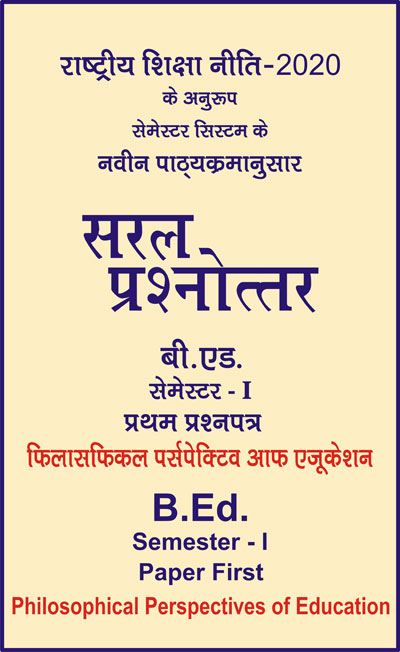

बी.एड. सेमेस्टर-1 प्रश्नपत्र-I - फिलासफिकल पर्सपेक्टिव आफ एजुकेशन (अंग्रेजी भाषा में)
Question- Self education is based on self-realization.
Answer -
Principles of Self-Education
As self-education is based on self-realization, and the process of self-realization is as permanent as that of education. All those actions which provide a natural sense of satisfaction and contentment, will promote the educative process. The contentment is the reaction of the soul, and hence not the same as mere satisfaction and pleasure. In following Rabindra Nath’s concept of self-education, the educand has to follow the three following principles:
- Independence : Rabindra Nath believed in complete freedom of every kind for the educand - the freedom of intellect, decision, heart, knowledge, action and worship. But in order to attain this freedom, the educand had to practise equanimity, harmony and balance. Through his practice the educand can learn to distinguish between the true and the false, the natural and the artificial, the relevant and the irrelevant, permanent and temporary, universal and individual, liberal and narrow, etc. Consequently, after making this distinction, the educand can bring about a harmony and synthesis in the true, natural, relevant, permanent and real elements that he has acquired. Once the level of freedom has been achieved, there is no danger of the individual straying from his path, because his sense, intelligence, emotional feelings and all other powers are directed by his ego.
-
Perfection :The second active principle underlying self-education is that of perfection. Perfection here implies that the educand must try to develop every aspect of his personality and all the abilities and powers with which he has been endowed by Nature. Hence, the aim of education is not merely passing examinations, acquiring degrees and certificates of merit. The sole aim of education is development of the child’s personality which is possible only when every aspect of the personality is given equal importance, when no part of the personality in neglected and no part is exclusively stressed.
-
Universality : Development of the individual remains imperfect and incomplete until he acquires an abiding faith in the universal soul, a part of which exists inside himself. And for this, it is necessary to indentify one’s own soul with the universal soul. Thus, education exists not in simple development but it inheres in literally a rebirth in which the individual rises above the limitations of his individual personality and loses this individuality in the universality in the universal soul.
|
|||||
अन्य पुस्तकें
एम ए सेमेस्टर-1 - अंग्रेजी - प्रथम प्रश्नपत्र - अंग्रेजी साहित्य 14वीं-17वीं शताब्दी
सरल प्रश्नोत्तर समूह
मूल्य: Rs. 400