 i
i 





|
बी एड - एम एड >> बी.एड. सेमेस्टर-1 प्रश्नपत्र-I - फिलासफिकल पर्सपेक्टिव आफ एजुकेशन बी.एड. सेमेस्टर-1 प्रश्नपत्र-I - फिलासफिकल पर्सपेक्टिव आफ एजुकेशनसरल प्रश्नोत्तर समूह
|
|
|||||||

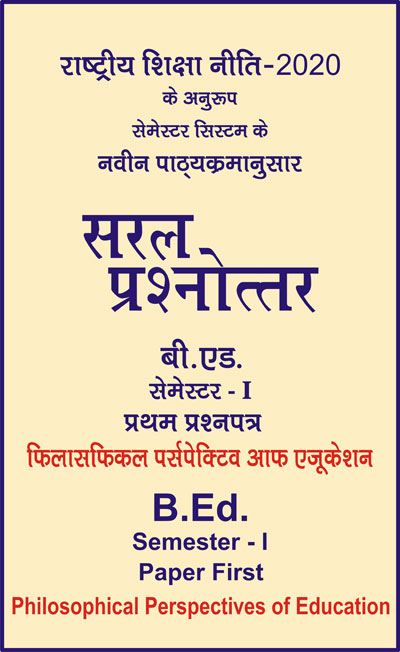

बी.एड. सेमेस्टर-1 प्रश्नपत्र-I - फिलासफिकल पर्सपेक्टिव आफ एजुकेशन (अंग्रेजी भाषा में)
Question- Explain the Aims of Education?
Answer -
Aims of Education
It has already been revealed that the aim of education is self-realization. According to R. N. Tegore, Universal soul is within himself and in Nature. Self-realization, means the realization of the universal soul in one’s self. Man’s aim of life is to achieve this status. His philosophy is very much influenced by the ‘Gita’ and the ‘Upanishads’. The aims of education of R. N. Tagore can, well, be ascertained under the following heads.
1. Integral Development : Defining the aim of education, Rabindra Nath says, "The fundamental purpose of education is not merely to enrich ourselves through the fullness of knowledge, but also to establish the bond of love and friendship between man and man."
2. Physical Development : Like Vivekananda, Rabindra Nath condemned the prevalent system of education which partially exercised the intellect only to the entire neglect of the body. According to Rabindra Nath, "Education of the body in the real sense, does not exist in play and exercise but in applying the body systematically to some useful work." Thus, the aims of physical development. Pointing out the value of physical activities, he emphasized or games in school educationat a part of personality development.
3. Psychological Develoment : Besides the Physical aim of education, Tagore equally lays emphasis upon the mental aim of education. Like Vivekananda, he is critical of the prevalent system of education which laid sole emphasis upon bookish learning. Presenting this attitude he says, "We touch the world not with our mind, but with our books. This is deplorable. Intellectualism takes us away from Nature and creates a gulf between man and man."
4. Harmony with Environment : In the end, the aim of education according to Rabindra Nath, is the harmony of the educand with the environment. The educand should know his environment and create harmony with it. To quote Rabindra Nath, "True education consists in knowing the use of any useful material that has been collected, to know its real nature and to build along with life a real shelter for life."
5. Earning Livelihood : Thus, about the aim of education, Tagore’s approach is realistic. He, however, does not favour the utilitarian aim of education. This is the objection against the imposition of British system of education upon India. He says, "Knowledge has two departments : one pure knowledge, the other utilitarian knowledge. Whatever is worth knowing is knowledge. It should be known equally by men and women, not for practical utility, but for the sake of knowing.....The desire to know is the law of human nature." In his own words, "One of the main aims of education is to prepare the individual for the service of the country."
Conclusion : The above discussion reveals, that the education is not a single approach to the life. However, it has multisided attack on the problems of man and brings about perfection in his life.
|
|||||
अन्य पुस्तकें
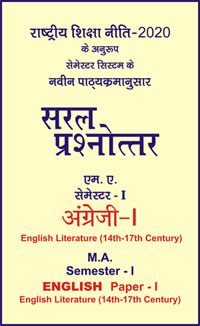
एम ए सेमेस्टर-1 - अंग्रेजी - प्रथम प्रश्नपत्र - अंग्रेजी साहित्य 14वीं-17वीं शताब्दी
सरल प्रश्नोत्तर समूह
मूल्य: Rs. 400