 i
i 





|
बी एड - एम एड >> बी.एड. सेमेस्टर-1 प्रश्नपत्र-I - फिलासफिकल पर्सपेक्टिव आफ एजुकेशन बी.एड. सेमेस्टर-1 प्रश्नपत्र-I - फिलासफिकल पर्सपेक्टिव आफ एजुकेशनसरल प्रश्नोत्तर समूह
|
|
|||||||

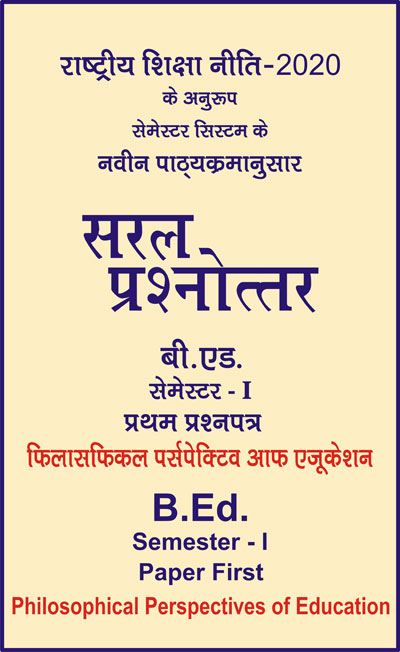

बी.एड. सेमेस्टर-1 प्रश्नपत्र-I - फिलासफिकल पर्सपेक्टिव आफ एजुकेशन (अंग्रेजी भाषा में)
Question- Describe the philosophical background of the theory of education propounded by J. Krishnamurti.
Answer -
J. Krishnamurti (1895-1986) is counted among the greatest thinkers of our time. He propounded a philosophy of education with serious moral and spiritual implication. He was a revolutionary thinker who rejected the validity of all authority external to an individual whether of the teacher, the book or the tradition. He pointed out that no individual, book or tradition may enlighten us about the truths.
Limitation of Reason: Krishnamurti does not consider intellect and reason as means of real knowledge. Thoughts basically originates from memory. It is past oriented. Its function is to correct applied sciences. Intellect cannot connect us to reality. Reason creates conflict, dichotomy, and problems in our life. It has an adverse impact on understanding. Imagination also takes us away from reality. Krishnamurti did not favour penance, Yoga or mystic experience to know reality. He did not consider himself a teacher or a Guru.
Importance of Knowledge of Self: To know oneself is the most important goal of life according to Krishnamurti. Self-knowledge is not the knowledge of unchanging, immortal, conscious self. It means knowing oneself in every moment.
Concentration: Concentration is a meditation through will. It is an effort to concentrate oneself on some object. Krishnamurti rejects concentration as a means of knowing reality. It creates dichotomy and conflict. It creates impediment in natural flow of consciousness. It makes one restless. A restless mind cannot know the reality.
Meditation
According to Krishnamurti meditation alone can lead us to reality. Meditation is spontaneous and without will. It is a spontaneous concentration on an object. This object becomes our sole concern for the moment. Consciousness alone exists in a particular moment. The distinction of the knower-known and knowledge is abolished in that moment. The only important thing is effortlessness and spontaneity.
Objective of Meditation
Meditation is a purposive activity. Its object may be concrete or abstract. The former is some object, the latter is some word or symbol. As meditation is spontaneous, it has some worldly or other worldly purpose.
"Desire and Effort"
Desire is neither the with nature force nor preserving force of meditation. Meditation is desireless. It does not require any conscious effort. One has to meditate on that on which he/she spontaneously concentrates. It is not a conscious selection of some objective. Some examples of meditation are looking at the wife or child, hearing the birds, walking through woods.
Totality of Consciousness
Our consciousness is total. Our sense organs do not get segregated but act together in harmony. It is an experience with division of sense orgAnswer -
Pure Consciousness
Meditation leads to pure consciousness which is not ideative or determined by particular efforts. It has no distinction of knower and known. Both get best into it. It has no consciousness of space and time. It is pure, transcendental, beyond thought or language.
Know Thyself
Meditation may be done anywhere and at any point of time, and in any posture. It is an awareness of ourselves from moment to moment. It leads to gradual liberation, non-attachment, simplicity, peace, love and compassion. It increases the boundary to self to cover the entire existence. Ordinary knowledge requires selection. Self-knowledge requires no selection. It is not conditioned by thought or action. It is beyond thought, beyond language.
"Importance of Present"
According to Krishnamurti the present is the most important for everyone. It may be connected with the past or future. One must learn to live in the present. Pure consciousness is not temporal. It has no goal as all goals are future-oriented. Wisdom is not thought. A wise man is beyond concepts, conflicts, ideas. It is a state of direct spontaneous understanding.
|
|||||
अन्य पुस्तकें
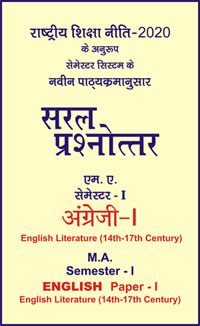
एम ए सेमेस्टर-1 - अंग्रेजी - प्रथम प्रश्नपत्र - अंग्रेजी साहित्य 14वीं-17वीं शताब्दी
सरल प्रश्नोत्तर समूह
मूल्य: Rs. 400