 i
i 





|
बी एड - एम एड >> बी.एड. सेमेस्टर-1 प्रश्नपत्र-I - फिलासफिकल पर्सपेक्टिव आफ एजुकेशन बी.एड. सेमेस्टर-1 प्रश्नपत्र-I - फिलासफिकल पर्सपेक्टिव आफ एजुकेशनसरल प्रश्नोत्तर समूह
|
|
|||||||

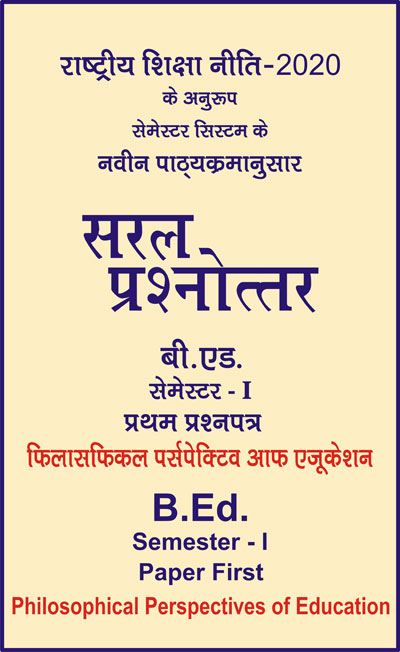

बी.एड. सेमेस्टर-1 प्रश्नपत्र-I - फिलासफिकल पर्सपेक्टिव आफ एजुकेशन (अंग्रेजी भाषा में)
Question- Describe Dewey’s contribution to modern teaching methods and curriculum.
Or
Describe the contribution of John Dewey to determine the modern methods of teaching and curriculum.
Answer -
Modern Teaching Methods - Ideas of Dewey in regard to the method of teaching are reflected in his works entitled, “How We Think” and “Interest and Effort in Education”. Here he said that the best method of teaching or education is that which is based on learning by doing. These activities should form a part of life. The method should aim at coordinating the subjects with activities and life. The child, according to Dewey, is the centre of education, and it is interest in the faculties that matter most to him.
Dewey has accepted the same thing in the following lines:
"The genuine principle of interest is the principle of recognized identity of the proposed line of action with the self that it lies in the direction of agents in self-expression." In other words, Dewey believed that self-expression of the child should be related to the activities that he takes up in school.
The Project Method, which is identified with the method of teaching enunciated by John Dewey, was introduced by Kilpatrick, one of the famous followers of John Dewey. It is believed that the ideals of John Dewey in regard to the method of teaching are reflected in this particular method.
It is correct also because the path of this method was originally drawn by John Dewey in the following words:
"First, that people have a genuine situation of experience that there be continuous activity in which he has interests for its own sake. Second, that a genuine problem develops with this situation as a stimulus to thought. Third, that he possesses the information and makes the information needed to deal with it. Fourth, that such a solution occurs to him for which he shall be responsible for developing in an orderly way. Fifth, that he has the opportunity and occasion to test his ideas by application to make their meaning clear and discover for himself their validity. (Democracy and Education)
Keeping in view the aforementioned ideas, we can say that a good method of education has the following steps:
(a) The initiative should lie with the children. They should propose what they actually do.
(b) Then they should be allowed to do only those things which help them build a certain attitude.
(c) Only that learning should be allowed which is necessary for the purposed activities.
(d) Lastly, these activities should be properly guided so as to add to the subsequent stream of experience.
These are summed up in the following five steps required for a method of teaching that John Dewey would propose:
(i) Activity
(ii) Problem
(iii) Data
(iv) Hypothesis
(v) Testing
Dewey and Curriculum - Like the school and education, Dewey had no rigid views about the curriculum. He believed that the curriculum should reflect the special life of the child and his activities in society.
Basing his ideas on these things, Dewey has laid down the following principles in regard to the curriculum:
(1) Flexibility : The curriculum should be flexible. It should not be pre-determined. It should be determined on the basis of the interest and experiences of the child and should be in accordance with social requirements. For a child at an elementary school, the curriculum will be different from that of a child at the secondary school.
Curriculum at the elementary school should be based on the fourfold interests of the child as envisaged by John Dewey, “Four interests are Paramount-interest”
(a) In conversation and communication,
(b) In equity and findings,
(c) In making or construction, and
(d) In artistic expression.
(2) Based on Experiences : The curriculum must follow the “progressive organization of knowledge consisting of educative experiences and problems.”
The curriculum should be so organized that it should enrich the experiences already acquired and the problems should be set so that they serve as a stimulus to the learner to add new experiences and ideas to the already existing ones. These new experiences and problems should grow out of the old ones, and that is how the process should go on. Educative experience, for John Dewey, has special significance. According to him, it is like a creative activity that leads to further experiences. It not only modifies the existing experience but also affects the subsequent ones. This educative experience should be above all and the books, teacher apparatus, etc., are subordinate to it. Socio-economic conditions are taken into consideration while framing the curriculum.
(3) Organization of the Subject - Subjects in the curriculum should be organized according to their utility. But it is not possible to give a definite order to these subjects as their utility cannot be predetermined. Dewey’s philosophy is that the knowledge acquired beforehand does not matter very much. It has to be based on the child’s own experience and, therefore, the importance of the subjects has to be determined in the process of life.
This is what he said in the following words:
"It is a futile attempt to arrange subjects in an order beginning with one having least work and going to that of maximum value – The only maximum value that can be set up is just the process of living."
According to Dewey, neither any subject is important nor secondary, neither any futile nor important. Activities are directed by problems of the actual life from the curriculum. He has himself said, "Men’s fundamental common concerns centre about food, shelter, clothing, household furnishing, and appliances commanded with production, exchange, and consumption."
(4) Curriculum to be Determined According to Instinct and Natural Capacity - According to Dewey, the curriculum should be constructed while keeping in view the innate tendencies, interests, and capabilities of the child. As already stated, it should be based on present experience. Different subjects should be drawn out of day-to-day life, and each subject should be naturally co-related. They should not be taught as if they are independent studies, but in a way as to look like a part of the entire process that keeps life going. The subject matter of the curriculum should also be co-related with the actual life of the child.
|
|||||
अन्य पुस्तकें
एम ए सेमेस्टर-1 - अंग्रेजी - प्रथम प्रश्नपत्र - अंग्रेजी साहित्य 14वीं-17वीं शताब्दी
सरल प्रश्नोत्तर समूह
मूल्य: Rs. 400