 i
i 





|
बी एड - एम एड >> बी.एड. सेमेस्टर-1 प्रश्नपत्र-I - फिलासफिकल पर्सपेक्टिव आफ एजुकेशन बी.एड. सेमेस्टर-1 प्रश्नपत्र-I - फिलासफिकल पर्सपेक्टिव आफ एजुकेशनसरल प्रश्नोत्तर समूह
|
|
|||||||

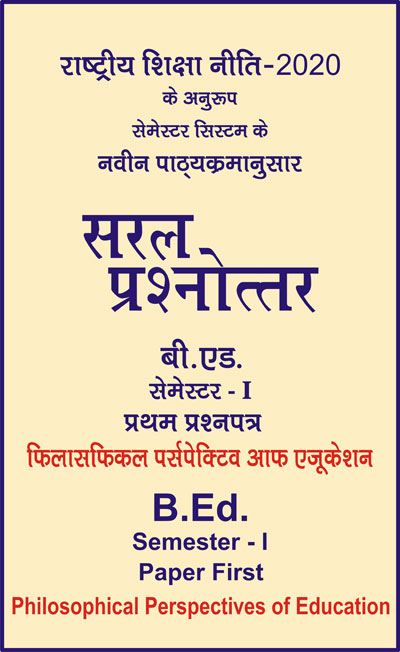

बी.एड. सेमेस्टर-1 प्रश्नपत्र-I - फिलासफिकल पर्सपेक्टिव आफ एजुकेशन (अंग्रेजी भाषा में)
Question- Discuss the different components of Plato’s theory and scheme of education.
Or
Explain in detail the educational thoughts of Plato.
Answer -
Plato’s Theory of Education
Plato sees education as the only true way to the permanent stability of the state. The hope of molding the citizens to the system of the community by legislation must always be futile. If the character of the people is sound, laws are unnecessary; if unsound, laws are useless. It is with this conviction that Plato starts to emphasize the importance of education in his ideal state. We in the 21st century believe that the road to better government and public service is through an appropriately conceived system of education. In fact, the origin of this idea goes back directly to Plato. The ultra-modern and rapidly-growing realization of education as a never-ending process, embracing adults as well as the young, was propounded by him. He clearly saw that education was more than the acquiring of basic facts and ideas in one’s childhood and adolescence and was the first to propose an elaborate system of adult training and education.
Plato’s general view of education sets forth the object of education, which is to turn the eye towards the light which the soul already possesses. What he really wants to say is that the whole function of education is not to put knowledge into the soul, but to bring out the best things that are latent in the soul, and to do so by directing it to the right objects. But how is this to be done? Plato’s Answer - to this question is that it can be done by providing the human soul with the right type of surroundings. That is why education in the case of Plato means bringing the soul into that environment which in each stage of its growth is best suited for its development. The overwhelming importance that Plato attaches to the environment is described in Republic. There he describes the human soul as a living organism and says that, just as a plant when sown in the ground develops according to the soil and the atmosphere it lives in, so it is with the soul.
In the Platonic system of education, because the main problem of education is simply to bring the soul into a particular surrounding, that is why nothing is said of direct teaching. He does not talk of the steps by which an object of knowledge is to be presented to the mind. Plato always supposes that the mind is active. Objects are not presented to it; it directs itself to objects. It moves towards every object of its environment because there is in it an attraction towards every object. This active spiritual force the teacher never tries to touch—at any rate, directly. The true business of the teacher, in fact, is to bring out what is best in his pupil: more truly, it causes itself in response to the right objects, and it is in setting them before his pupils that the true art of the teacher lies. In this, there is something of the theory of “reminiscence” which was propounded by Plato in his dialogue, Meno. The theory of reminiscence which is expounded by Plato says that our soul has seen in a former life all things which it learns in this world, and our learning is a mere remembrance of that life, which flashes to the mind when some fact of an object stirs what we may call an association of ideas. The object only gives a clue; the soul itself responds to its suggestion. But everything depends on the clue. The environment makes the soul, in the sense that the soul determines itself by its environment. He who would make the soul beautiful must set her in a fair posture. This is the reason for that high place which Plato assigns to art and especially to music as a means of education.
Plato’s Scheme of Education
Plato’s scheme of education represents a state-controlled system of compulsory education for both sexes. Every member of the state has to be prepared for a particular class either for ruling, fighting, or producing class.
The education which is imparted in the beginning is equal for all. Thus, Plato maintains the principle of equality in education at least in the beginning of it. From the scheme, it, however, appears that education in this system was meant for everyone. But, in fact, if it is to be carefully observed, education in the Republic is exclusively meant for those who are to become the rulers of the ideal state. In such a system of education, the art of citizenship is identified with the art of ruling. Plato’s system of education is divisible into two parts, namely, (i) Elementary Education and (ii) Higher Education, which we examine as follows:
(I) Elementary Education - In the Platonic scheme of education, education for the first ten years shall be predominantly physical. Every school should have a gymnasium and a playground. The entire curriculum of education will consist of play and sports, and during this period of education, the health of children will be so nicely developed so as to make all medicine unnecessary. It is unfortunate, says Plato, that by living a life of indolence and luxury, men have filled themselves like pools with waters and winds—flatulence and catarrh—is not this a disgrace? he asks.
But mere athletics and gymnastics will simply develop the physical side of life, and Plato does not want to develop a nation of prize-fighters and weight lifters. The gentler side of life should also be developed and Plato has recommended the study of music for the achievement of that object. Music also moulds character and, therefore, shares in determining social and political issues. Music is also valuable because it brings refinement of feeling and character. It also preserves and restores health. There are some diseases which can be treated only through the mind, and the mind can be cured through musical medicine.
After sixteen, the individual practice of music must be abandoned, though choral singing may go on throughout life. Thus, the education up to the age of seventeen or eighteen was to be a general education in music and gymnastics and also in the elements of science. Plato looked at poetry with disfavour, for poetry was an outrage on understanding and injuriously excited the feelings. It had an emotional rather than a rational appeal. Something of mathematics, history, and science may also be taught. But these difficult subjects should be smoothed into verse and beautified with songs. But even these studies should not be forced upon the mind of the child.
(II) Higher Education - We shall face a very hard time when we arrive at the age of twenty and face the first great elimination test of what they have learnt in all these years of equal education. There shall be a ruthless weeding out, and the examination will be both theoretical and practical. Those who fail in this elimination test will be assigned the economic work of the community—businessmen, clerks, factory workers, and farmers.
Those who pass the elimination test will receive ten more years of education and training in body and mind. Natural and mathematical sciences are to be taught. Emphasis is laid on mathematics, including arithmetic, plane and solid geometry, astronomy, and dialectics. At the age of 30, they will face the second elimination test, which will be far severer than the first. Those who fail in this test will become the auxiliaries and executive aides and military officers of the state. Plato, in this connection, says that, “we shall tell these young people that the divisions into which they have fallen are God-decreed and irrevocable. We shall tell them the myth of the metals and appeal to them in the name of God. ‘Citizens, you are brothers, yet God has framed you differently, men of gold, men of silver, and men of iron’.”
A further selection will be followed by another 5 years of study of dialectics in order to see who is capable of freeing himself from sense perception. But even at this stage, the education of the ruler is incomplete. After five years of study of dialectics, there come 15 years of practical experiences. During this period of 15 years, they will be exposed to all sorts of temptations. “They will be tried more thoroughly than gold is tried in the fire” so that the incorruptibility and self-control of the future rulers of the country may be established beyond doubt.
Now at the age of 50, those who have stayed the course of this hard and long process of education are to be introduced to their final task of governing their country and their fellow citizens. They will pass most of their time in philosophical pursuits. “Yet, each when his turn comes is to devote himself to the hard duties of public life, and hold office for their country’s sake, not as a desirable but an unavoidable occupation.”
It is, in this way, after receiving a sort of perfection, as it were, the rulers will exercise power in the best interest of the state. The ideal state, thus, will be realized and its people balanced in soul, will be just and happy.
|
|||||
अन्य पुस्तकें
एम ए सेमेस्टर-1 - अंग्रेजी - प्रथम प्रश्नपत्र - अंग्रेजी साहित्य 14वीं-17वीं शताब्दी
सरल प्रश्नोत्तर समूह
मूल्य: Rs. 400