 i
i 





|
बी एड - एम एड >> बी.एड. सेमेस्टर-1 प्रश्नपत्र-I - फिलासफिकल पर्सपेक्टिव आफ एजुकेशन बी.एड. सेमेस्टर-1 प्रश्नपत्र-I - फिलासफिकल पर्सपेक्टिव आफ एजुकेशनसरल प्रश्नोत्तर समूह
|
|
|||||||

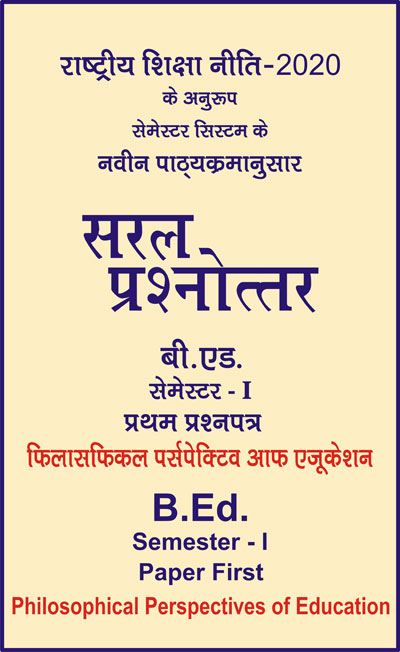

बी.एड. सेमेस्टर-1 प्रश्नपत्र-I - फिलासफिकल पर्सपेक्टिव आफ एजुकेशन (अंग्रेजी भाषा में)
Question- Who was Paulo Freire? Discuss in detail the influence on Freire.
Answer -
Paulo Freire (1921-1997)
Paulo Freire was one of the most influential philosophers of education of the twentieth century. He worked wholeheartedly to help people both through his philosophy and his practice of critical pedagogy. A native of Brazil, Freire’s goal was to eradicate illiteracy among people from previously colonized countries and continents. His insights were rooted in the social and political realities of the children and grandchildren of former slaves. His ideas, life, and work served to ameliorate the living conditions of oppressed people.
Paulo Reglus Neves Freire was born in Recife in 1921. Freire experienced firsthand the political instability as well as the economic Hardships of the 1930s. Freire’s father died during the economic depression of the thirties, and as a young child, Freire came to know the crippling and dehumanizing effects of hunger. Young Freire saw himself being forced by the circumstances to steal food for his family, and he ultimately dropped out of elementary school to work and help his family financially. It was through these hardships that Freire developed his unyielding sense of solidarity with the poor. From childhood on, Freire made a conscious commitment to work in order to improve the conditions of marginalized people.
Freire managed to finish elementary school between Recife and Jaboatão and later attended the secondary school, Oswaldo Cruz, in Recife. Aluízio Pessoa de Araújo, the principal of Oswaldo Cruz secondary school, agreed to allow Freire to study at a reduced tuition because Freire’s family could not afford to pay the full tuition. To reciprocate the favor, Freire began to teach Portuguese classes at Oswaldo Cruz in 1942. Freire then went on to study law at Recife’s School of Law from 1943 to 1947.
Influences on Freire
Paulo Freire’s thought and work were primarily influenced by his historical context, the history of Brazil, and his own experiences. Some of the early and lasting influences on Freire were his parents, his preschool teacher, and Aluízio Pessoa de Araújo, the principal of Oswaldo Cruz secondary school. The ideas that contributed to the development of Freire’s philosophy and work are existentialism, phenomenology, humanism, Marxism, and Christianity. The ideas of G.W.F. Hegel, Karl Marx, Anísio Teixeira, John Dewey, Albert Memmi, Erich Fromm, Frantz Fanon, and Antonio Gramsci were Freire’s major influences.
Freire learned tolerance and love from his parents. Freire’s father died in 1934 due to complications from arterial sclerosis. Freire was 13 years old. Freire’s mother assumed the responsibility of providing for her four children. Even though Freire’s childhood was not an easy one due to the death of his father and the economic conditions of the 1930s, Freire’s parents had created an environment of tolerance and understanding in his home.
Eunice Vasconcelos was Freire’s preschool teacher, and she greatly influenced his understanding of school and learning. Because of this experience, Freire came to love learning, and he came to see school as a place where one is encouraged to explore one’s curiosity. Another important influence on Freire was Aluízio Pessoa de Araújo. Freire’s mother approached him to ask if young Freire could study at his school. The only problem was that Edeltrudes was not able to pay for Freire’s tuition. He accepted Freire into the school anyway because he was committed to teaching for the sake of helping people, and this proved to be a lasting influence on Freire.
Freire’s thought was deeply influenced by a number of G.W.F. Hegel’s ideas. Most notably are Hegel’s process metaphysics, social ethics, phenomenology, and the tension of the master versus slave dialectic.
Throughout his writings, Freire makes the claim that the ontological vocation of all human beings is to become more human. While many of Freire’s readers and critics speculate that Freire assumes a substance metaphysics that reifies some types of human nature, other interpretations assume a Hegelian process metaphysics. If we assume the validity of this latter interpretation, then just as the unfolding of history culminates in Absolute Spirit for Hegel, similarly with Freire, it is the process of becoming that is important. Freire was also influenced by Hegel’s communitarianism and worked with individual students always with the aim of benefiting the community as a whole. Freire understood the importance of empowering individuals (positive rights) and protecting them (negative rights), which is a consequence of Freire’s understanding of the role, importance, and commitment to the betterment of the community. Freire also adopted phenomenology as his preferred method for not only making sense of his context but also for figuring out a way to help his students learn about their own contexts. The emphasis on subjectivity from phenomenology was used by Freire to help his students understand their own realities through their learning of language, or as Freire called it, “the word,” and to learn together how to speak their word. Hegel’s tension of the master versus slave dialectic became for Freire the tension between the oppressor and the oppressed.
Karl Marx’s ideas were foremost influential on Freire’s own philosophy. Among the ideas from Marx that influenced Freire are Marx’s class consciousness, his concept of labour, and false consciousness. For Marx, when a person gains awareness of their class consciousness, they become cognizant of their economic place in their society and thus of their class interests. Freire’s concept of conscientização points to the process of becoming aware not only of one’s class but also more broadly of the roles one’s race, gender, physical ability, and so forth play in our society. Freire, like Marx, believed that it is through our work that humans can change the world. Whether Freire’s students were construction workers, janitors, factory workers, or shoemakers, Freire used their work and the words for their tools both to teach them how to read and write as well as to share with his students how each of them transformed the world and made their world through their work. Just as Marx pointed to the spiritual loss from alienated labour that workers experienced, likewise Freire aimed to prevent this loss and restore human dignity to the work of his students by sharing with them the transformative power of their work. What Freire refers to as the internalization of a master has its basis in Marx’s concept of false consciousness. For Marx, false consciousness takes place whenever a member of the proletariat mistakenly believes that they are not being exploited, or that by working harder, they will someday gain economic stability and freedom. For Freire, Marx’s false consciousness takes place when the oppressed internalize the ideology of the oppressor.
Freire was also influenced by Anísio Teixeira’s work and philosophy. Teixeira’s work called for the democratization of Brazilian society through education. Teixeira opposed the education of his time, which was exclusive to the upper classes, and thus promoted a social elitism that left the majority of Brazilians without access to education. Teixeira worked toward establishing a free, public, secular education that would be accessible for everyone. Freire was moved by Teixeira’s questioning of why the average Brazilian did not embrace a democratic spirit, and both Teixeira and Freire agreed this was due to the traditionally hierarchical and authoritarian ways in which people had related to each other during the time that Brazil had been a Portuguese colony, and afterward while slavery continued being an institution in Brazil. Freire, like Teixeira, believed and worked toward the possibility of developing a democratic sensibility through education.
John Dewey’s philosophy of education was another influence on Freire’s philosophy and work, particularly in the classroom dynamics, and the dynamic between the teacher and the students. Teixeira had been a student of Dewey, and the importance of fostering a democratic sensibility through education became central to Freire. Freire believed the classroom was a place where social change could take place. Freire, like Dewey, believed that each student should play an active role in their own learning, instead of being the passive recipients of knowledge. Consequently, Dewey and Freire both agreed that the ideal teacher would be open-minded and confident in their competence while also open-minded to sharing and learning from his or her students. Both Dewey and Freire were critical of teachers whose dispositions were undemocratic, who transmitted information from the expert to the student, and who lacked curiosity and confidence to continue learning from their students.
Existentialism was another significant influence on Freire’s philosophy. Freire believed that human beings are free to choose and thus responsible for their choices. While on one hand, Freire did very much take into account the historical context created by the legacy of slavery in Brazil, he never believed the historical conditions determined the future for him, his students, or Brazilian society. On the contrary, Freire espoused the existential belief that humans need not be determined by the past. When Freire taught literacy classes, he not only taught his students how to read and write. Freire shared conscientizaakoo and, with this, the awareness that his students were free to choose the life they created for themselves.
Erich Fromm’s ideas also helped Freire discern how to bring about human liberation vis-a-vis the dominant ideology of Brazil at the time. Before Critical Theory, human reason was interpreted to be our source of rational, autonomous choices and enlightened dialogue. Marx problematized this assumption, however, when he pointed to false consciousness as one of the ways through which the dominant ideology becomes an instrument of domination that controls human choices and promotes alienation. Freire relied on Fromm’s understanding of human freedom and Fromm’s discussion of control to come to his own understanding of the dynamic between the oppressors and the oppressed. Like the existentialists before him, Fromm advocated the creation of human values instead of following pre-established and unquestioned norms. Freire was influenced by Fromm’s understanding of freedom to develop the liberatory praxis of critical pedagogy whereby the people in the classroom contributed to each other’s conscientizaakã and thus embrace and claim their own freedom. In order to explain the difference between humanism and humanitarianism, Freire used the biophilic and necrophilic concepts from Fromm. In his book The Heart of Man (1967), Fromm distinguishes between two types of approaches to helping others. One approach is to feel the need to control the situation and the people who are being helped. The other approach is to allow the situation and the people to be what they potentially may be. Fromm characterizes the people who feel the need to control as necrophilic because in their need to control other people and the events in life itself, they deny people and life of their own possibilities. According to Fromm, those who are able to allow other people and events to unfold into what they may become are characterized as being biophilic because they respect the freedom and creativity of human beings and trust in the unfolding of life’s events.
The ideas of Albert Memmi and Frantz Fanon helped Freire to make sense first of the Brazilian and then the Latin American, African, and Asian colonized experience. Although Freire was deeply influenced by Marx’s analysis of economic classes, the Brazilian and Latin American histories could not be understood by class analysis alone due to the history of colonization and slavery. Freire agreed with Memmi that the primary reason for colonization was economic. Freire believed there were two reasons why the literacy rate was so low in northeastern Brazil. The first was because the Portuguese were primarily concerned with the economic exploitation of Brazil and its people. As was the case in other Latin American countries, Catholic priests did educate some of the people and advanced to some degree the interests of the natives; however, according to Freire’s understanding, and influenced by Memmi, the colonization of Brazil was first and foremost an economic endeavor. The exploitation of the land’s resources and the people’s labour through the institution of slavery and the aftermath of slavery was the second reason the literacy rate was extremely low. In agreement with Teixeira, Freire believed the lack of democratic sensibility and education in Brazil was precisely due to the history of colonization in Brazil.
Besides Memmi, Fanon was deeply influential in Freire’s understanding of the colonized experience. Perhaps the most salient influence of Fanon on Freire was Fanon’s idea that the oppressed must be actively engaged at every step of gaining their own freedom. In other words, the oppressed cannot and should not be liberated by anyone other than themselves. Fanon’s discussion of language, in his case the difference between “proper French” and his Creole French, also influenced Freire’s understanding and teaching of Portuguese in such a way that Freire always acknowledged the legitimacy of his students’ way of speaking the Portuguese language.
Freire’s philosophical development was also influenced by several of Antonio Gramsci’s ideas. Gramsci’s idea of the organic intellectual influenced Freire to believe in the importance of educating and fostering the development of his working-class students. Influenced by Fanon and Gramsci, Freire was committed to the idea and practice of legitimizing the experiences and knowledge of his students so that organic intellectuals would emerge. These organic intellectuals would in turn be in the best position to contribute to the solutions of the community’s problems since they would know their community, the intricacies of their context and their problems and solutions better than any expert who had studied the problem merely academically.
Equally important to the theoretical influences here mentioned was the spiritual influence that Christianity had on Freire’s philosophy. Freire was particularly influenced by liberation theology as it developed in Latin America. Liberation theology prioritized fighting poverty, political activism, practice, and social justice. Freire’s philosophy was very much in line with the grassroots, bottom-up organization of liberation theology, which emphasized the importance of practicing the teachings of Jesus Christ instead of obediently following the established orthodox church hierarchy.
|
|||||
अन्य पुस्तकें
एम ए सेमेस्टर-1 - अंग्रेजी - प्रथम प्रश्नपत्र - अंग्रेजी साहित्य 14वीं-17वीं शताब्दी
सरल प्रश्नोत्तर समूह
मूल्य: Rs. 400